Hong Kong Space Museum to launch new sky show “STARMAP to the Unseen Universe” (with photos)

Source: Hong Kong Government special administrative region

The Hong Kong Space Museum will launch a new sky show, “STARMAP to the Unseen Universe”, at its Space Theatre from tomorrow (May 15), leading audiences on a journey and traversing 13.8 billion years of cosmic history in search of the universe’s origin from the Earth.

The Milky Way Galaxy is a galaxy composed of hundreds of billions of stars. The sun is one of the stars within this massive galaxy. The show will take audiences on an adventure beyond the boundaries of the solar system, explore the spiral arms of the Milky Way, and witness the birth and death of stars. The show will also reveal the all-consuming power of a black hole and showcase the process of the collision and merging of galaxies into a larger galaxy. Audiences can also closely admire the luminous members of the Pleiades star cluster in the constellation Taurus and the Orion Nebula.

The 28-minute show will be screened until November 14. Screening times are 3.30pm and 8pm on weekdays, and 2pm and 6.30pm on weekends and public holidays respectively. Tickets priced at $30 (front stalls) and $40 (stalls) are now available at the Hong Kong Space Museum Box Office and URBTIX (www.urbtix.hk). For details of the show, please visit hk.space.museum/en/web/spm/shows/sky-show/starmap.html, or call 2721 0226 for enquiries.

The Hong Kong Space Museum, located at 10 Salisbury Road, Tsim Sha Tsui, Kowloon, is closed on Tuesdays (except public holidays).

Ends/Wednesday, May 14, 2025
Issued at HKT 12:30

DH signs service agreements with medical institutions newly included in Elderly Health Care Voucher Greater Bay Area Pilot Scheme (with photos)

Source: Hong Kong Government special administrative region

The Department of Health (DH) today (May 14) signed service agreements with 12 Mainland medical institutions newly included in the Elderly Health Care Voucher Greater Bay Area Pilot Scheme. It serves as a curtain raiser for the commencement of services at these medical institutions within this year, as announced in the Chief Executive’s 2024 Policy Address on the extension of the Pilot Scheme to cover nine Mainland cities in the Guangdong-Hong Kong-Macao Greater Bay Area (GBA).

The signing ceremony was held at the Central Government Offices. Addressing the ceremony, the Director of Health, Dr Ronald Lam, said, “On behalf of the HKSAR Government, I would like to express my gratitude to the Health Commission of Guangdong Province and the health authorities of relevant cities for their continuous support and assistance to the HKSAR Government in further extending the Pilot Scheme to cover all nine Mainland cities in the GBA. It will not only provide greater convenience and flexibility to the eligible Hong Kong elderly persons to safeguard and address their medical needs for a happy and healthy ageing life, but also further promote medical co-operation in the GBA to jointly build a ‘Healthy Bay Area’.”

​The 12 medical institutions newly included in the Pilot Scheme are:
 

GBA city Name of medical institution
Guangzhou Guangdong Provincial Hospital of Chinese Medicine
Guangdong Clifford Hospital
Shenzhen
(including the Qianhai Shenzhen-Hong Kong Modern Service Industry Co-operation Zone)
Shenzhen Hospital of Southern Medical University
Peking University Shenzhen Hospital
Zhuhai The Fifth Affiliated Hospital, Sun Yat-sen University
Zhuhai People’s Hospital
Foshan The First People’s Hospital of Foshan
The Eighth Affiliated Hospital of Southern Medical University
(Previously: Shunde Hospital of Southern Medical University)
Huizhou Huizhou Central People’s Hospital
Zhongshan Zhongshan Hospital of Traditional Chinese Medicine
Jiangmen Jiangmen Central Hospital
Zhaoqing The First People’s Hospital of Zhaoqing

 
With the expansion of the number of pilot medical institutions from the current seven to 19 in total, together with the two existing service points operated by the University of Hong Kong-Shenzhen Hospital, eligible Hong Kong elderly persons will be able to use the Elderly Health Care Voucher (EHCV) for outpatient healthcare services at a total of 21 service points in the GBA.

“The DH will continue to actively collaborate with the newly included pilot medical institutions to finalise the follow-up arrangements in accordance with the service agreements, such as personnel training, financial arrangements and system configuration. We will strive for the newly included pilot medical institutions to launch the relevant arrangements gradually by the fourth quarter of this year, so as to enable eligible Hong Kong elderly persons to use EHCVs at more service points as soon as possible, and to make better use of the primary healthcare services to improve their health and gain a greater sense of happiness. Co-operation on medical and health issues is an important component of the development of the GBA and is vital to promoting the well-being of the people in the region,” said Dr Lam.

Launched by the Government in 2009, the Elderly Health Care Voucher Scheme (EHVS) currently subsidises eligible Hong Kong elderly persons aged 65 and above with an annual voucher amount of $2,000 (with the accumulation limit set at $8,000) for them to choose in their own community private primary healthcare services that best suit their health needs. The Government launched the Pilot Scheme last year to extend the coverage of EHCVs to suitable medical institutions in the GBA. As of September of the same year, the coverage of EHCVs has been extended to seven integrated medical/dental institutions located in Guangzhou, Zhongshan, Dongguan and Shenzhen.
 
Upon the launch of the Pilot Scheme last year, as of end-March 2025, about 13 350 eligible elderly persons have used EHCVs to pay for the fees of outpatient healthcare services received at medical institutions under the Pilot Scheme, involving 24 645 voucher claim transactions and a total claimed amount at approximately $32.16 million. 
 
In addition, the “Cross-boundary Health Record” and “Personal Folder” functions of the eHealth mobile application will also be applicable to the medical institutions under the Pilot Scheme, with a view to offering convenience for Hong Kong citizens to self-carry their electronic health records for cross-boundary uses.

Members of the public may refer to the EHVS website (www.hcv.gov.hk) or call the hotline (2838 2311) for more information on the EHVS.


LCQ2: Work on attracting enterprises and investments

Source: Hong Kong Government special administrative region

Following is a question by the Hon Jeffrey Lam and a reply by the Acting Secretary for Commerce and Economic Development, Dr Bernard Chan, in the Legislative Council today (May 14):

Question:

In recent years, the Government has been vigorously promoting the work on attracting enterprises and investments. It is learnt that Invest Hong Kong (InvestHK) assisted a total of 539 overseas and Mainland enterprises in setting up or expanding their businesses in Hong Kong last year. In this connection, will the Government inform this Council:

(1) of the number of overseas and Mainland enterprises which InvestHK has assisted in establishing a presence in Hong Kong or setting up regional headquarters in Hong Kong since January this year; the home countries of such enterprises, as well as the industries to which they belong;

(2) of the policies and measures currently put in place by the Government in respect of land, taxation, etc. to support overseas and Mainland enterprises in establishing a presence in Hong Kong; and

(3) given that the Secretary for Labour and Welfare has pointed out at a special meeting of the Finance Committee of this Council held to discuss the Estimates of Expenditure 2025-2026 that Hong Kong Talent Engage (HKTE) would provide comprehensive one-stop support to incoming talents, of the total number of applications received by HKTE since January this year; among such applications, of the areas in which support has been provided?

Reply:

President,

After consulting the Development Bureau (DEVB), the Financial Services and the Treasury Bureau, the Labour and Welfare Bureau, as well as the Office for Attracting Strategic Enterprises (OASES), my consolidated response to the Hon Jeffrey Lam’s question is as follows:

InvestHK Hong Kong (InvestHK) is responsible for promoting inward direct investment to Hong Kong by attracting Mainland and overseas enterprises to set up or expand in the city. In 2024, InvestHK assisted 539 Mainland and overseas enterprises in establishing and expanding their businesses in Hong Kong, representing an increase of over 40 per cent year on year. On a pro-rata basis, the figure well exceeded the performance indicator as set out in the 2022 Policy Address by the Chief Executive. On the other hand, the number of companies in Hong Kong with overseas or Mainland parent companies in 2024 reached a record high of 9 960. It included 1 410 regional headquarters, an increase of over 5 per cent year on year.

From January to April this year, InvestHK assisted 223 Mainland and overseas enterprises, representing an increase of 13 per cent as compared with the same period last year. These enterprises are expected to bring in direct investment of over $22.3 billion and create over 4 900 jobs within their first year of operations or expansion. Over one-fourth of these enterprises indicated their setup of international or regional headquarters in Hong Kong. The top five places of origin of those enterprises are the Mainland, the United States, Japan, the United Kingdom and Singapore; and the top five sectors are the financial services and fintech sector, family office, innovation and technology sector, tourism and hospitality sector, and consumer products sector.

Separately, the current-term Government established OASES, which is directly under the Financial Secretary, to attract high-potential and representative strategic innovation and technology enterprises from around the globe. So far, OASES successfully attracted 84 strategic enterprises, many of which plan to establish their international or regional headquarters in Hong Kong.

InvestHK and OASES provide Mainland and overseas enterprises with one-stop customised support services, including introducing tax regime and tax concessions of Hong Kong, assisting enterprises in identifying premises for operations, and assisting them in following up on matters relating to talent admission.

In terms of tax policy, Hong Kong has been practicing a simple, territorial-based and low-tax regime. Hong Kong’s profits tax rates are very competitive internationally, with the first $2 million of profits of corporations taxed at the rate of 8.25 per cent, and the profits above that amount taxed at 16.5 per cent. Besides, tax types in Hong Kong are simple in that there is not any kind of capital gains tax, withholding tax on dividends or interest, estate duty, value-added tax, goods and services tax, nor digital services tax. The Government of the Hong Kong Special Administrative Region (HKSAR) has also been strategically utilising tax measures to facilitate the development of different industries. Tax concessions introduced over recent years have benefitted multiple industries or taxpayers, including the asset and wealth management industry, maritime industry, insurance industry, and taxpayers with intellectual property income.

In terms of assisting enterprises in identifying suitable premises, given the diverse backgrounds of enterprises, InvestHK and OASES focus on understanding and catering to the different needs of individual enterprises. In respect of land supply, the DEVB has been collaborating with InvestHK and OASES to introduce to Mainland and overseas enterprises interested in setting up in Hong Kong the distribution of existing and future economic land in the territory, including how the Government will adopt an “industry-led” approach in planning strategic projects such as the Northern Metropolis (NM). In particular, as each New Development Area in the NM has its own industry positioning, the next few years will see considerable output in development land and floor space for innovation and technology and other emerging industries, as well as industries with traditional strengths, to move in. As for enterprises interested in setting up in Hong Kong and participating in the construction of buildings for industries, the DEVB will recommend development land for their consideration. It will also support relevant policy bureaux in exploring and adopting various modes of land disposal and land premium arrangements by giving consideration to restricted tender or direct land grant in addition to the traditional practice of open tender. When a project enters the design and construction stages, the DEVB will also provide one-stop services by co-ordinating with relevant departments to expedite approvals.

Apart from focusing on attracting enterprises and investment, the current-term Government is also dedicated to attracting talents from overseas and the Mainland. Since its establishment on October 30, 2023, the Hong Kong Talent Engage (HKTE) strives to provide comprehensive one-stop support to talents. From January to April 2025, over 45 000 new applications under various talent admission schemes were received, of which over 35 000 applications were approved. The support services provided by the HKTE to incoming talents and their families include the following:

(a) Themed seminars: To cater for the needs of incoming talents, leaders from various industries and admitted talents were invited to share career information and tips on starting a business. Since its establishment and up to end-April 2025, the HKTE has organised 33 online and offline themed seminars;

(b) Job fairs: Job fairs help job-seeking talents to match with employers direct, so as to help incoming talents to look for jobs based on their skills, making better use of their professional competencies. As at end-April 2025, the HKTE has organised, co-organised and participated in 17 job fairs in total;

(c) Enquiry and support matching services: The HKTE’s online platform currently connects with about 90 designated working partners to provide talents with advice and services in respect of job matching, accommodation, education, banking and insurance services, business and corporate services, integrated settlement services as well as networking and community through online matching services. The online platform has processed over 41 000 enquiries, mainly involving matters such as talent schemes, visa and job seeking, and made around 12 000 referrals of support service requests so far;

(d) Integration activities: Participation in volunteer services allows incoming talents to strengthen their connections with the local community, thereby facilitating their better integration into local society. As at end-April 2025, the HKTE has organised, in collaboration with volunteer groups, three integration activities; and

(e) Cantonese learning classes: The classes help enhance the Cantonese speaking and listening skills of incoming talents, and assist them in understanding the local culture and customs, thereby expediting their integration into local society. As at end-April 2025, the HKTE has organised 28 Cantonese learning classes.

The HKSAR Government will continue to make every effort to attract more enterprises and talents from the Mainland and overseas.

Ends/Wednesday, May 14, 2025
Issued at HKT 12:21
NNNN
Assessment Forms

Source:

Share this:

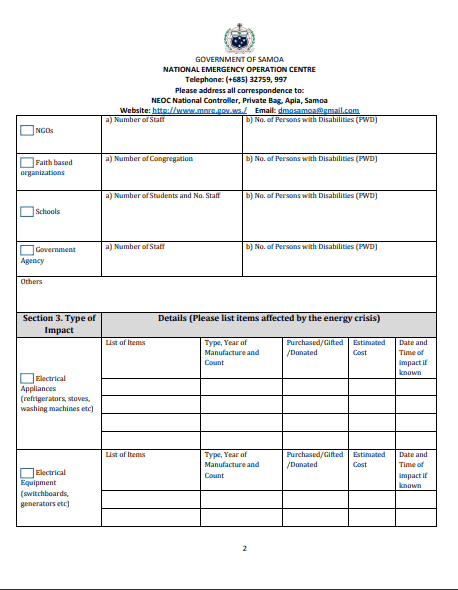
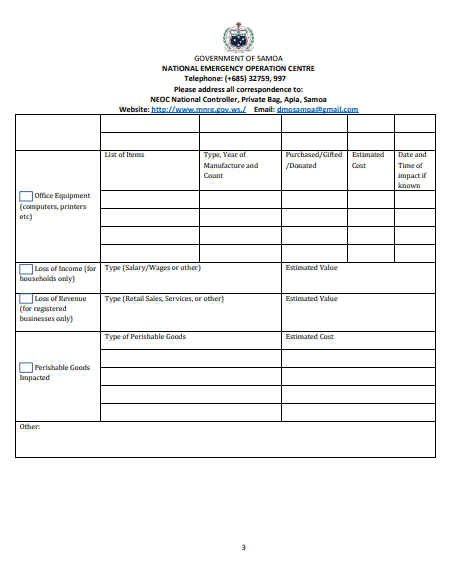
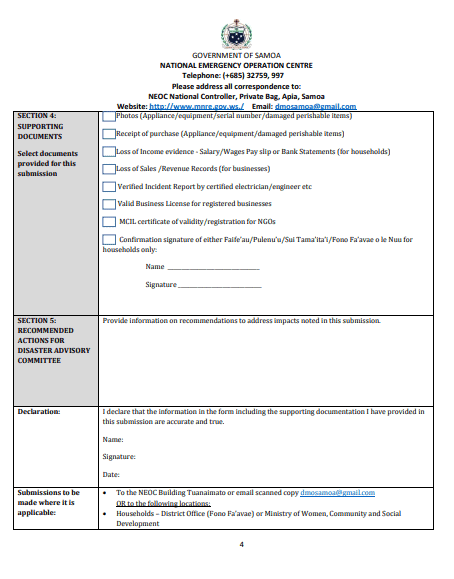
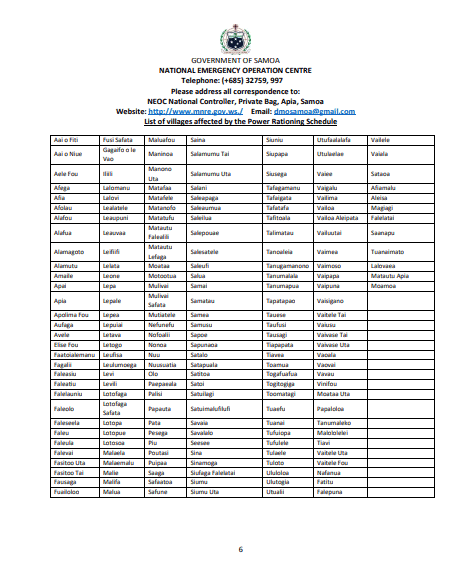
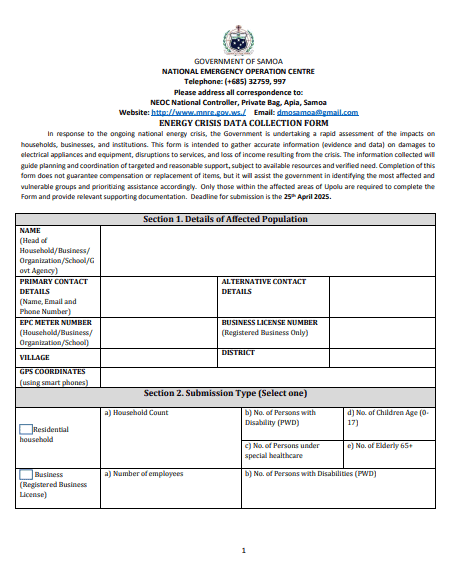
The Government is conducting an official assessment to better understand the energy crisis’s impacts on households, businesses, and institutions. Only residents and businesses in designated areas of Upolu are required to complete the form by 25 April 2025.

The form will collect information on electrical equipment damage, disruptions to operations or services and financial losses. All Applicants are required to provide their EPC meter number, supporting documentation (e.g., photos, receipts, or certified assessments) for verification.

Download Assessment Form Here

Share this:

WORLD BOOK DAY 2025 – BOOK DRIVE FOR THE CAMPUS OF HOPE

Source:

Share this:

[UNESCO OFFICE, APIA – 15 April 2025] – Talofa lava and greetings from the UNESCO Apia Regional Office for the Pacific.

Each year, on 23 April, the world celebrates the power and beauty of books. Books are gateways to new worlds, offering opportunities for learning, entertainment, and understanding. They connect us to others and provide a window into different perspectives. Books expand our knowledge, enhance critical thinking and increase empathy.

In celebration of World Book Day 2025, UNESCO invites you to not only celebrate books, but also to help others discover the joy of reading.

This year, UNESCO is organising a book drive for the Campus of Hope, a sanctuary for Samoan children and youth under the Samoa Victim Support Group (SVSG). The Campus of Hope offers a safe haven for children and youth to heal and rebuild their lives.

Please drop off your book donations by 22 April 2025 at our office on the 3rd floor of the John Williams Building, Beach Road. We encourage donations of English and Samoan books in good condition. Children’s books are especially welcome!

All books will be donated to the children and youth of the Campus of Hope to help establish a library in the foreseeable future. We look forward to your support in promoting the transformative power of books and reading.

For any enquiries or further information, please contact Ms Nina Manuson at ma.manuson@unesco.org or +6857187370.

ENDS.

SOURCE – UNESCO Apia Regional Office

Share this:

LCQ9: Construction or redevelopment of small houses

Source: Hong Kong Government special administrative region

LCQ9: Construction or redevelopment of small houses 
Question:
 
Some residents of the New Territories have reflected that the pace of processing applications for the construction or redevelopment of small houses in the North District of the New Territories is slower compared to other districts. In this connection, will the Government inform this Council:
 
(1) given that in its reply to a question raised by a Member of this Council on the Estimates of Expenditure 2025-2026, the Government indicated that, as at the end of last year, there were as many as 3 686 small house applications under processing in the North District, with only 95 applications being approved last year, and that the Islands District and the Sai Kung District also faced a similar situation of a low number of approved applications and a high proportion of backlogged cases, whether the Government has put in place targeted improvement measures to enhance the efficiency of processing applications for the construction or redevelopment of small houses in these three districts; if so, of the details; if not, the reasons for that;
 
(2) given that according to government information, only around 100 staff members of the Lands Department are currently involved in processing of the small house applications, and that the respective numbers of small house applications and small house redevelopment applications under processing as at the end of last year were 10 513 and 1 664, how the Government will redeploy its manpower to expedite the processing of these backlogged cases; and
 
(3) given that the Government is implementing an arrangement that allows applications for a Certificate of Compliance (i.e. a Certificate of Compliance or “No Objection to Occupy”) by self-certification of compliance for New Territories Exempted Houses, and that this arrangement has been first implemented as a pilot scheme by the District Lands Office, Yuen Long, whether the Government will consider extending this pilot scheme to villages under all rural committees in the Northern Metropolis; if so, of the details; if not, the reasons for that?
 
Reply:
 
President,
 
The New Territories Small House Policy has been implemented since December 1972 to allow an indigenous villager to apply for permission to, for once in his lifetime, erect a small house on a suitable site within his own village (Note 1). According to the performance pledge, the Lands Department (LandsD) will process (Note 2) not less than 2 300 small house applications per year. For redevelopment applications, as archaic leases and houses are generally involved, the cases are more complicated and considerable time may be spent on checking the records. LandsD in general completes the processing of around 600 redevelopment applications per year.
 
The reply to various parts of the question raised by the Hon Chan is as follows:
 
(1) and (2) To streamline the processing of small house and redevelopment applications and speed up the approval process, LandsD enhanced the processing procedures in October 2021 and January 2023, including:
 
(i) To commence the procedures under various aspects in parallel, such as verification of land ownership and lot boundaries, and consultation with the relevant departments;
(ii) To simplify the procedures for handling objections;
(iii) To conduct face-to-face meetings with applicants for direct discussion;
(iv) To delegate the approval of relatively straightforward cases to officers under the District Lands Officer, and only non-straightforward cases will be submitted to the District Lands Officer or District Lands Office (DLO) Conference for approval;
(v) To enhance the supervision by LandsD on DLOs, including regular follow-up on the progress of processing applications.
 
The implementation of the above procedures has achieved results in terms of expediting the processing of small house and redevelopment applications. The average number of small house applications processed by LandsD each year increased to more than 2 500 cases in the years from 2022 to 2024, surpassing the department’s performance pledge of 2 300 cases, while the number of redevelopment applications completed by LandsD per year also increased from around 480 in 2022 to around 650 in 2024.
 
While it is mentioned in the question that the proportion of small house applications approved in 2024 as compared to the cases pending completion of processing in certain districts (including the North District, the Islands District, and the Sai Kung District) is relatively lower, we believe this is mainly due to the fact that applications involve relatively complex geographical features (such as remote locations or proximity to slopes, which require more rigorous technical assessments) and a larger amount of applications received in these respective districts.
 
In fact, a total of about 360 small house applications were received on average per year from 2022 to 2024 in the North District, the Islands District and the Sai Kung District, with an average of over 800 cases (Note 3) processed each year; the number of applications pending completion of processing also decreased from a total of over 6 100 at the end of 2021 to about 5 270 by the end of March 2025, representing an overall decrease of approximately 14 per cent. As for redevelopment applications, a total of about 100 and 150 applications were received and processed respectively on average per year from 2022 to 2024 in the three districts. The number of applications pending completion of processing decreased from a total of over 840 at the end of 2021 to about 710 by the end of March 2025, representing an overall decrease of approximately 16 per cent.
 
At present, around 100 staff of LandsD, mainly deployed to the eight DLOs in the New Territories, are involved in processing small house and redevelopment applications. As these staff are also responsible for other land administration duties within the DLOs, the above figure is provided for general reference only. LandsD will continue to review and enhance the procedures for processing small house and redevelopment applications (including the introduction of the self-certification of compliance scheme mentioned below) to expedite the approval. In addition, LandsD will strengthen the role of its headquarters in monitoring the processing and approval of applications in various districts and more flexibly allocate resources across districts to accelerate the processing of applications.
 
(3) After a DLO approves an application to build a small house, the applicant has to apply to LandsD for and obtain the Certificates of Exemption in accordance with the Building Ordinance (Application to the New Territories) Ordinance (Cap. 121) before commencing the construction works. After the works are completed, the applicant has to submit a construction completion report to the DLO. The DLO will issue a Certificate of Compliance (CoC) if, having conducted on-site checking, it is satisfied that the applicant has complied with all the relevant conditions, requirements and obligations.
 
To expedite the development of small houses, LandsD implemented a self-certification scheme of CoCs on a pilot basis in January this year, which allows lot owners to appoint registered professionals at their own expense to prepare and submit a self-certification of compliance, thereby optimising the use of resources in the industry and expediting the approval process. LandsD will conduct detailed inspection checks on randomly selected cases. At the same time, LandsD will also streamline and expedite the approval process for applications submitted under the scheme, with the target of completing the processing of cases within 10 weeks upon receipt of all required documents, and within 14 weeks for cases subject to random checking.
 
To ensure the orderly implementation of the self-certification scheme, a pilot scheme was first implemented at the DLO, Yuen Long. In view of the very positive response from Heung Yee Kuk and various stakeholders, and their wish for LandsD to extend the scheme to other DLOs as soon as possible, after taking into account factors such as the processing status of applications for CoCs by various DLOs, demand and manpower resources, LandsD plans to extend the coverage of the scheme to the DLO, North in the third quarter of this year. Details will be announced in due course. With the operational experience gained from the pilot scheme, LandsD will then decide whether and how to regularise the arrangement.
 
Note 1: The small house shall neither contain more than three storeys nor exceed a height of 8.23 metres (27 feet); and the roofed-over area shall not exceed 65.03 square metres (700 square feet).
 
Note 2: The number of small house applications processed by LandsD annually according to its performance pledge covers the applications which LandsD approves, rejects or classifies as non-straightforward cases for further processing in a particular year.
 
Note 3: As the processing of applications received during a year may not be completed within the same year, the applications processed in a particular year and its number may not correspond with the applications received in the same year and its number.
Issued at HKT 16:38

NNNN

Government welcomes passage of Companies (Amendment) (No.2) Bill 2024

Source: Hong Kong Government special administrative region

     The Government welcomed the passage of the Companies (Amendment) (No.2) Bill 2024 by the Legislative Council today (May 14) to introduce a company re-domiciliation regime in Hong Kong.
 
     The Secretary for Financial Services and the Treasury, Mr Christopher Hui, said, “The Amendment Ordinance puts in place a simple and accessible mechanism for company re-domiciliation. It addresses the demand of companies incorporated elsewhere with major business in Hong Kong for re-domiciliation to Hong Kong, and is conducive to our efforts in proactively attracting enterprises and investment, thereby generating business for various local professional services sectors as well as increasing investment and job opportunities.”
 
     Under the company re-domiciliation regime, non-Hong Kong-incorporated companies which fulfil the requirements concerning company background, integrity, member and creditor protection, and solvency, etc, may apply to re-domicile to Hong Kong while maintaining their legal identity as a body corporate and ensuring business continuity. The property, rights, obligations and liabilities, as well as the relevant contractual and legal processes of the companies would not be affected during the process. If, after re-domiciliation, the company’s actual similar profits are also taxed in Hong Kong, the Government will provide the company with unilateral tax credits for elimination of double taxation. In general, re-domiciled companies will be regarded as companies incorporated in Hong Kong. They have the same rights as any Hong Kong-incorporated companies of their kind in Hong Kong, and will be required to comply with the relevant requirements under the Companies Ordinance (Cap. 622).
 
     The Amendment Ordinance will take effect on May 23. The company re-domiciliation regime will be open for application starting from the same day. The Companies Registry will, on the same day, set up a new thematic section on its website to provide the application details and relevant information for reference. The Integrated Companies Registry Information System will also be enhanced to process applications.

LCQ1: Development of autonomous vehicles

Source: Hong Kong Government special administrative region

Following is a question by the Hon Shang Hailong and a reply by the Secretary for Transport and Logistics, Ms Mable Chan, in the Legislative Council today (May 14):

Question:

LCQ11: Management of water resources

Source: Hong Kong Government special administrative region

LCQ11: Management of water resources 
Question:
 
     Water charges in Hong Kong have not been adjusted for nearly 30 years since February 1995. The Waterworks Operating Accounts have recorded persistent deficits since 1999, and such deficits have increased substantially from less than $1 billion in the 2013-2014 financial year to about $2.4 billion in the 2022-2023 financial year. Moreover, it has been reported that the water charges in Hong Kong are among the lowest in advanced cities. While the water charges in other advanced countries or cities (such as Japan and Singapore) account for about 1 per cent to 2 per cent of the local household income, Hong Kong’s average water charges represent only less than 0.2 per cent of its household income. In this connection, will the Government inform this Council:
 
(1) whether it has studied the reasons why persistent deficits have been recorded in the operation of waterworks in Hong Kong, apart from the apparently low water charges, and whether the authorities have examined the reasons for persistent deficits from the management and operation perspectives; if it has studied, of the details, and how the authorities will make improvements;
 
(2) given that according to the paper submitted by the Government to the Panel on Development of this Council on December 13, 2023, the main source of water supply for Hong Kong is Dongjiang water purchased from the Guangdong Province under the “package deal deductible sum” approach, and the annual ceiling water prices from 2024 to 2026 will be over $5 billion, whether the authorities have actively enlisted support from the relevant ministries of the Central Government and proactively discussed with the authorities of the Guangdong Province to explore ways to optimise the existing mode of water supply (especially the water prices); and
 
(3) whether it will actively consider privatising the Water Supplies Department; if so, of the specific timetable and roadmap; if not, the reasons for that?
 
Reply:
 
President,
 
     The Water Supplies Department (WSD) has all along been committing to providing the public with reliable, sufficient and quality fresh water.  Over the years, the WSD has been constructing many waterworks facilities to meet the needs of social development and the public on the one hand, while on the other hand containing fresh water demand growth through various water conservation and water loss management initiatives. The WSD is exploiting new water resources including desalinated seawater, reclaimed water (Note 1) and treated grey water (Note 2) to diversify the water supply portfolio and build resilience in fresh water supply.
 
     Besides, through adopting new technology to enhance operational cost-effectiveness and streamline business processes, the WSD effectively controls the capital cost of water supply.
 
     The Government will review the level of water tariff periodically based on the principles of “user pays” and “service cost recovery”, taking into account the social and economic situations, affordability of the consumers, financial performance of waterworks operations and the views of the stakeholders, etc. Water is a daily necessity for people, and the water tariff adjustment will have significant impact on people’s livelihood and the operation of various trades and industries. The Government needs to consider the factors very carefully in order to balance the public finance position and the impact on the public.
 
     The reply to the various parts of the question raised by the Hon Yim is as follows:
 
(1) The number of water accounts has increased from 2.2 million in 1998 to 3.27 million in 2024 (an increase of about 49 per cent).  To meet the new service demands, the WSD has increased the number of waterworks facilities substantially between 1998 and 2024, including an increase of 43 per cent in the length of water mains from about 5 900 km to about 8 500 km, a rise of 8 per cent in the number of service reservoirs from 215 to 232, and an increase of 8 per cent in the number of pumping stations from 177 to 191, which results in a continuous increase in the associated operational and maintenance expenses. The Composite Consumer Price Index also increased by 40 per cent over the same period. Besides, water tariff has not been adjusted since 1995 (except for the adjustment of water fees for non-local vessels in 1996). Taking all these factors into account, the Waterworks Operating Accounts (WOA) have continuously recorded a deficit since 1998-99, and the cost recovery rate also dropped to about 75 per cent.
 
     To control the cost of water supply and improve waterworks operating conditions, the WSD has been committing to improving water resources management and making good use of technology to streamline business processes, reduce water loss and save energy consumption. Meanwhile, the WSD has reduced its establishment from about 6 100 in 1998 to about 4 700 in 2024.
 
     In addition, the WSD has implemented water loss management initiatives, including the replacement and rehabilitation of about 3 000 km of aged water mains between 2000 and 2015 and the implementation of Risk-based Improvement Programme of Water Mains and Water Intelligent Network in recent years. These efforts have reduced the leakage rate of government water mains from around 25 per cent in 2000 to around 13.4 per cent at present. The WSD has also spared no efforts in promoting water conservation to defer the need for building additional waterworks facilities, thereby lowering the operational, maintenance, and depreciation expenses associated with water supply, alleviating the pressure from the rising costs and achieving better cost-effectiveness.
 
     Other measures that have been implemented to enhance the cost-effectiveness of waterworks facilities include controlling private water main leakage, installing smart water meters, and upgrading the WSD’s energy management system to save the energy cost.
 
     To control the cost of water supply more effectively in the long run, the WSD is formulating an overall digital transformation roadmap to implement a series of digitalisation projects and measures in phases, including the establishment of the WSD’s Central Operation Management Centre, Internet of Things platform, cloud data centre, digital twin and hydraulic model applications, etc, with a view to improving the operational efficiency and stability of water supply, and reducing energy consumption. By implementing the aforementioned measures and making timely and suitable adjustments to water tariff, the performance of the WOA could be improved in the long run.
 
(2) The price for the Hong Kong Special Administrative Region Government to purchase Dongjiang (DJ) water includes the costs incurred by the mainland for supplying DJ water to Hong Kong, such as the costs for infrastructure, system operation and maintenance, etc, as well as the cost of measures to protect the quality of DJ water supplied to Hong Kong. The fees do not include the costs of the Mainland on ecological conservation and other aspects including the opportunity costs of the control of development in the protection zones along the basin, and the prohibition of activities such as quarrying, mining and extensive poultry farming within the protection zones, etc. The price of DJ water will be reviewed every three years upon each renewal of the DJ water supply agreement, and adjusted in a reasonable and appropriate manner based on the established mechanism which takes account of a number of objective factors including changes in the exchange rate between Renminbi and Hong Kong dollar, changes in the relevant price indices of Guangdong (GD) and Hong Kong, as well as increase in operation costs. In fact, the increase of annual ceiling water price for the 2024 to 2026 DJ water supply agreement is lower than the changes in the exchange rate and price indices mentioned above.
 
     Since 2021, DJ water supply agreement has adopted the “package deal deductible sum” approach. Hong Kong can import DJ water based on the city’s need. If there is a high local yield and the amount of DJ water required is below the pre-set annual supply ceiling, a price deduction, according to the actual amount of water supplied, will be made to the annual ceiling water price. This approach provides greater flexibility in the control of water storage level, preventing wastage of DJ water resources and saving energy cost for water delivery. Also, both the GD and Hong Kong sides agreed that the “package deal deductible sum” approach should be maintained at least up to 2029.
 
(3) As mentioned above, water is a daily necessity for people. A highly reliable water supply service is extremely important and has significant impact on people’s livelihood and the operation of various trades and industries. While there are examples where the water supply business is privatised, we are also aware that such operation arrangement may not necessarily bring overall benefits to the society. On the contrary, private investors may charge the public a higher water fee for the sake of profit, or be reluctant to invest resources in maintaining and repairing aging water pipes and other water facilities to control costs. The Government currently does not have plans to privatise the WSD.
 
Note 1: Reclaimed water is a water resource generated by further processing treated effluent from sewage treatment works.
 
Note 2: Water collected from bathrooms, wash basins, kitchen sinks and laundry machines etc. is known as grey water. Along with harvested rainwater, the grey water can be treated and reused for non-potable purposes such as toilet flushing.
Issued at HKT 15:36

NNNN

LCQ21: Deepening international exchanges and co-operation

Source: Hong Kong Government special administrative region

LCQ21: Deepening international exchanges and co-operation 
Question:
 
     In the country’s Report on the Work of the Government this year, it was mentioned that Hong Kong must deepen international exchanges and co-operation. The Hong Kong Special Administrative Region Government is also actively attracting overseas companies to Hong Kong and helping Mainland companies go global to align with the overall development strategy of the country. In this connection, will the Government inform this Council:
 
(1) how it will promote alignment between Hong Kong’s financial services industry and national policies to leverage Hong Kong’s unique advantages, reinforce its connectivity with both the Mainland and the world, and actively promote international exchanges and co-operation; whether it will consider providing further support to financial services enterprises to expand into new markets and broaden their international networks;
 
(2) as it is learnt that many Hong Kong enterprises, business associations, non-profit organisations, and international trade organisations possess extensive overseas networks, whether the Government has compiled the relevant statistics; if so, of the details; how the Government will leverage the power and resources of non-governmental organisations to foster citizen diplomacy;
 
(3) to align with the country’s overall development strategy, will the Government review and optimise the division of responsibilities and functions of different government departments or public organisations responsible for promoting trade (such as the Economic and Trade Offices, the Hong Kong Trade Development Council, Invest Hong Kong, and other overseas offices), so as to avoid overlapping structures and enable them to focus more on delivering services under existing policies;
 
(4) whether the Government will formulate specific policy measures to support and sponsor various enterprises and organisations to participate in industrial and commercial, and financial exhibitions, etc, in overseas countries in order to promote commercial co-operation with Middle East countries and Belt and Road countries, and to promote Hong Kong to such countries; if so, of the details; if not, the reasons for that; and
 
(5) whether the Government has a comprehensive plan to tell good stories of Hong Kong to the outside world through targeted publicity and promotion strategies, and to better leverage Hong Kong’s international advantages to attract more international financial institutions and investors to establish presence in Hong Kong?
 
Reply:
 
President,
 
     Having consulted the Financial Services and the Treasury Bureau, the consolidated reply to the question raised by the Hon Robert Lee is as follows:
 
     The Outline of the 14th Five-Year Plan for National Economic and Social Development of the People’s Republic of China and the Long-Range Objectives Through the Year 2035 (14th Five-Year Plan) supports Hong Kong to enhance its status as an international financial centre, strengthen its functions as a global offshore Renminbi (RMB) business hub, an international asset management centre and a risk management centre, as well as deepen and expand the mutual access between the financial markets of the Mainland and Hong Kong.
 
     In this regard, the Hong Kong Special Administrative Region (HKSAR) Government has been committed to deepening the interface of Hong Kong’s financial services industry with national policies in accordance with the 14th Five-Year Plan. For example, in terms of mutual market access, the Stock Connect has made some breakthroughs over the past few years, including the inclusion of exchange-traded funds and the addition of eligible stocks of foreign companies primarily listed in Hong Kong. This has become the most reliable channel for international investors to access the Mainland securities market. In terms of global offshore RMB business, at present, Hong Kong has the world’s largest offshore pool of RMB funds, currently processing about 80 per cent of global offshore RMB payments. On attracting Mainland enterprises to list in Hong Kong, as driven by a series of listing enhancement measures, there are currently over 1 480 Mainland enterprises listed in Hong Kong. The Hong Kong Exchanges and Clearing Limited (HKEX) has established listing avenues for new economy with weighted voting rights structures, and specialist technology companies as well as the technology enterprises channel, with a view to accurately addressing the financial service demands of Mainland’s emerging innovation and technology industries and leveraging Hong Kong’s strengths to serve our country’s needs.
 
     We also continue to deepen exchanges and co-operation with the global financial community, actively strengthen and expand our circle of friends with the global community, organise major financial events of global significance such as the Asian Financial Forum, the Wealth for Good in Hong Kong Summit and the Global Financial Leaders’ Investment Summit, in a bid to further enhance the voice and influence of our country and Hong Kong in the international financial community and showcase to the international investors the strengths and opportunities of Hong Kong as an international financial centre.
 
     In addition, the HKSAR Government, regulators and the HKEX are committed to promoting Hong Kong’s financial services industry, securities market and fundraising platform to overseas and Mainland enterprises and investors (including target markets such as the Middle East and the Association of Southeast Asian Nations regions), through organising and participating in different thematic flagship summits, outreach activities, thematic roadshow events, etc, with a view to strengthening Hong Kong’s linkage with overseas and Mainland markets, fostering financial market co-operation, as well as facilitating the local financial services industry to open up new markets.
 
     We will continue to deepen and step up our efforts to seize the national development opportunities, bringing more new opportunities to the industry and continuing to contribute to our country’s development as a financial powerhouse.
 
     On the other hand, the HKSAR Government has been actively promoting the sustainable development of Hong Kong as an international trade centre through diversified measures. The global trade landscape and geopolitics are rapidly changing, with parts of the supply chains shifted to the Global South and Belt and Road (B&R) countries, while Mainland enterprises are also proactively establishing their presence abroad. Hong Kong’s rich experience in international trade and world-class professional services will be of assistance to such Mainland enterprises in re-deploying their global supply chains. According to the 2024 Policy Address, Invest Hong Kong (InvestHK) and the Hong Kong Trade Development Council (HKTDC) set up in December 2024 a high value-added supply chain services mechanism for attracting Mainland enterprises to establish international or regional headquarters in Hong Kong for managing offshore trading and supply chain, and providing one-stop professional advisory services for enterprises in Hong Kong looking to go global. The mechanism is conducive to Hong Kong’s economic development on the one hand, and facilitates the deepening of its international exchanges and co-operation on the other hand, thus responding to meet Premier Li Qiang’s expectations for Hong Kong, as set out in his work report this year, integrating into the overall national development while making contribution to the country.
 
     Besides, the HKSAR Government will continue to organise a number of outbound missions to B&R markets to assist Hong Kong enterprises and professional services to further explore business opportunities and build long-lasting collaborative relationships with relevant local enterprises and organisations. We will also continue to actively organise various major events to promote Hong Kong’s advantages and facilitate business matching and project participation between Hong Kong and B&R countries. In addition, the HKTDC’s overseas network has already covered the major markets along the B&R, including regions of the Middle East. By leveraging its global network, the HKTDC will continue to launch diversified outreach activities, information platforms, large-scale international exhibitions and conventions, to highlight Hong Kong’s opportunities and role as a two-way business and investment platform, and facilitate the co-operation among enterprises of the Mainland and Hong Kong, investors and professional service providers, as well as the project owners from B&R countries.
 
     For overseas exhibitions activities, the HKSAR Government strives to encourage and provide funding support for non-listed Hong Kong enterprises to upgrade and restructure, enhance competitiveness of enterprises as well as sectors and conduct promotional activities through various funding schemes and measures, including the Dedicated Fund on Branding, Upgrading and Domestic Sales, the SME Export Marketing Fund and the Trade and Industrial Organisation Support Fund. Enterprises/organisations could apply for funding to participate in promotional activities such as exhibitions in markets outside Hong Kong to develop their businesses. The HKTDC has also been actively leading Hong Kong companies to participate in large-scale exhibitions overseas and set up Hong Kong pavilions in selected large-scale exhibitions. In addition, the HKTDC offers preferential participation rates and a range of value-added services, including the arrangement of business matching meetings, for Hong Kong companies to grasp the opportunities to promote their products and services.
 
     Currently, the HKSAR Government has 14 overseas Hong Kong Economic and Trade Offices (ETOs). Together with the offices of the HKTDC and InvestHK worldwide, Hong Kong has set up offices in 68 cities around the world, covering 129 countries, including emerging markets. The ETOs, InvestHK’s Dedicated Teams for Attracting Businesses and Talents based in the ETOs and its consultant offices in other locations, as well as the HKTDC’s offices are responsible for different aspects of work, while collaborating from time to time to generate synergy. The trio promote bilateral economic and trade relations between Hong Kong and overseas economies. InvestHK and the HKTDC mainly serve the business community. InvestHK is responsible for promoting inward direct investment to Hong Kong. Through its teams based in Hong Kong, the Dedicated Teams for Attracting Businesses and Talents based in the ETOs, as well as consultant offices in other locations, the department has all along been reaching out to a wide spectrum of companies in different sectors and industries around the world to attract and assist them to set up or expand their businesses in Hong Kong, and offering one-stop customised support services, from the planning to implementation stages. As for the HKTDC, it is responsible for trade promotion as well as facilitating, assisting and developing trade in Hong Kong. Through organising international exhibitions, conferences and business missions, the HKTDC creates business opportunities in the Mainland and international markets for Hong Kong enterprises. The ETOs are committed to maintaining close communication and exchanges with the international community and overseas stakeholders in different sectors (including government officials, think tanks, media organisations, academics, cultural and business groups and other key opinion leaders in countries under their purview), promoting and explaining the HKSAR Government’s important policies and Hong Kong’s unique advantages under “one country, two systems”, with a view to telling the good stories of Hong Kong and promoting economic and trade development between Hong Kong and overseas.
 
     Meanwhile, the ETOs will strengthen ties and co-operation with foreign chambers of commerce in Hong Kong and the local political and business sectors, and take the opportunity of the latter’s overseas visits to collaborate in promoting Hong Kong’s latest developments and major policy measures through different forms of activities, and jointly tell the good stories of Hong Kong from multiple perspectives.
Issued at HKT 15:33

NNNN