PROCLAMATION OF EMERGENCY – 30-DAY ENERGY CRISIS

Source:

Share this:

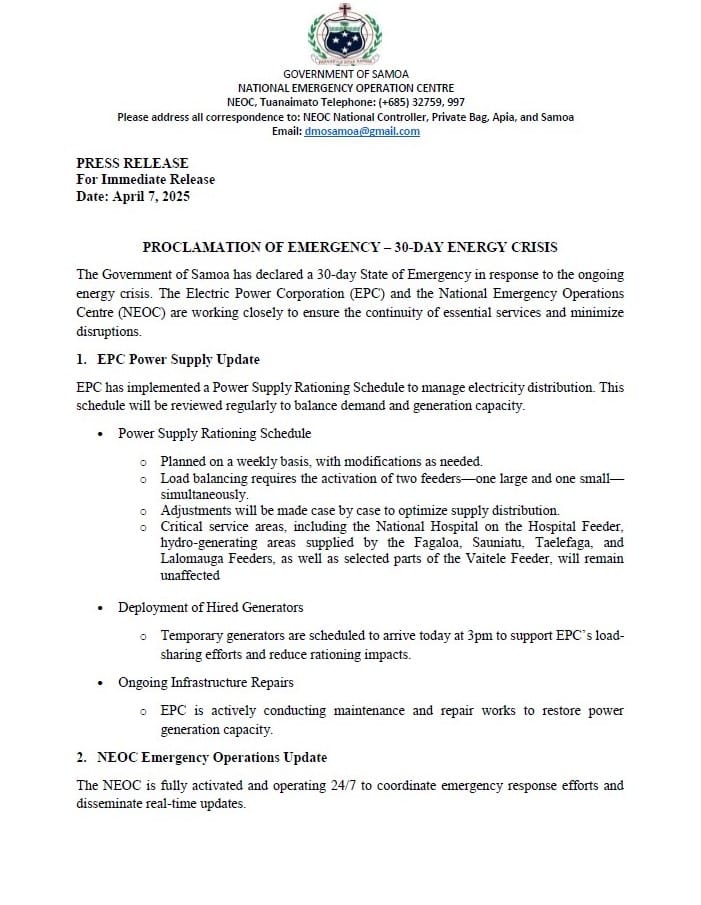
[PRESS RELEASE April 7, 2025] – The Government of Samoa has declared a 30-day State of Emergency in response to the ongoing energy crisis. The Electric Power Corporation (EPC) and the National Emergency Operations Centre (NEOC) are working closely to ensure the continuity of essential services and minimize disruptions.

1. EPC Power Supply Update

EPC has implemented a Power Supply Rationing Schedule to manage electricity distribution. This schedule will be reviewed regularly to balance demand and generation capacity.

 Power Supply Rationing Schedule

Planned on a weekly basis, with modifications as needed.

Load balancing requires the activation of two feeders—one large and one small—simultaneously.

Adjustments will be made case by case to optimize supply distribution.

Critical service areas, including the National Hospital on the Hospital Feeder, hydro-generating areas supplied by the Fagaloa, Sauniatu, Taelefaga, and Lalomauga Feeders, as well as selected parts of the Vaitele Feeder, will remain unaffected

 Deployment of Hired Generators

Temporary generators are scheduled to arrive today at 3pm to support EPC’s load-sharing efforts and reduce rationing impacts.

 Ongoing Infrastructure Repairs

EPC is actively conducting maintenance and repair works to restore power generation capacity.

2. NEOC Emergency Operations Update

The NEOC is fully activated and operating 24/7 to coordinate emergency response efforts and disseminate real-time updates.

Sector-Based Impact Assessments

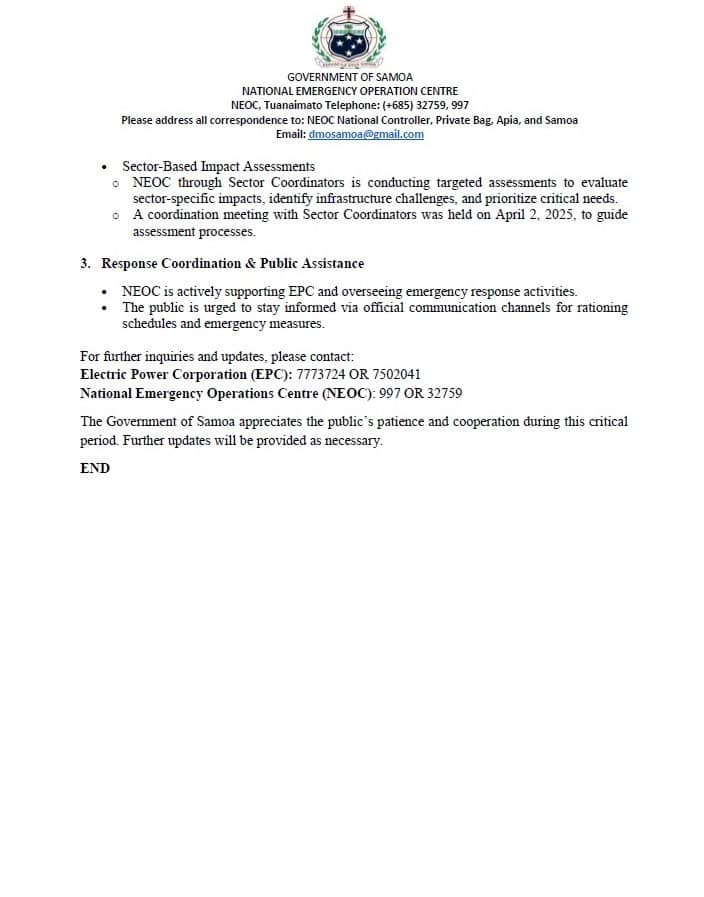
NEOC through Sector Coordinators is conducting targeted assessments to evaluate sector-specific impacts, identify infrastructure challenges, and prioritize critical needs.

A coordination meeting with Sector Coordinators was held on April 2, 2025, to guide assessment processes.

3. Response Coordination & Public Assistance

 NEOC is actively supporting EPC and overseeing emergency response activities.

 The public is urged to stay informed via official communication channels for rationing schedules and emergency measures.

For further inquiries and updates, please contact: Electric Power Corporation (EPC): 7773724 OR 7502041 National Emergency Operations Centre (NEOC): 997 OR 32759

The Government of Samoa appreciates the public’s patience and cooperation during this critical period. Further updates will be provided as necessary.

END.

POLOAIGA O FA’ALAVELAVE TUTUPU FA’AFUASE’I MO LE 30 ASO AUĀ LE TULAGA AFĀINA O LE ‘ELETISE UA I AI NEI.

[PEPA O FA’AMATALAGA Aso Gafua, 07 Aperila 2025] – I le fa’amamaluina ai e le Malo o le 30 Aso o le Poloaiga o Faalavelave Tutupu Fa’afuase’i i le atunu’u atoa, e saili fofō ai i le mafatiaga o feagai nei ma le Faalapotopotoga o Malosi’aga Faa ‘Eletise [EPC] i le tau faasoasoaina o le ‘eletise i nisi o afio’aga i Upolu, o lo’o fa’aauau pea ona galulue vāvālalata le Ofisa Tutotonu mo le Fa’afoeina o Fa’alavelave Fa’afuase’i ma Matuiā [NEOC] ma le EPC ia mautinoa o lo’o fa’aauau pea le auaunaga mo’omia e fa’aitiitia ai nisi fa’afitauli e toe tutupu mai.

1. Tala lata i le auaunaga a le EPC mo le ‘eletise.

O lo’o faagasolo pea le faasoasoa o le ‘eletise ma mata’itū fa’afitauli e alia’e mai i taimi uma. O lea fetu’una’iga o lo’o iloilo toto’a mai lea taimi i lea taimi ina ia gafatia ma o gatusa ma le mana’omiaga;

 Fa’asoasoaina o le ‘eletise i taimi ma aso fa’atulagaina.

Fa’atulaga le galuega fa’asoasoa mo le ‘eletise i le vaiaso fa’atasi ma suiga pe a mana’omia.

Ia paleni tutusa laina malolosi o le ā fa’aāogajna i le taimi e tasi, e aofia ai le laina malosi tele ma le laina malosi laititi.

Fetu’unā’iga talafeagai mai mataupu taitasi auā le fa’aleleia ma le fa’asoaina atu o le ‘eletise.

Auaunaga i laina mālolosi o le ‘eletise mo nofoaga ma’ale’ale e aofia ai le Falema’i Tele i Moto’otua, ma nofoaga o lo’o fa’alagolago i le ‘eletise e gaosia mai le suāvai e pei o Fagaloa, Sauniatu, Ta’elefaga ma le laina malosi i Lalomauga, fa’apea se vaega o le laina malosi i Vaitele o lo’o tumau pea ona lē a’afia i le ‘eletise fa’asoasoa.

 Afi ‘Eletise Fa’aāoga Fa’avaitaimi

Ua fuafua e taunuu mai i le itula e 3:00 i le asō ‘Afi ‘Eletise lē tumau e fesoasoani i le fa’asoasoaina o le ‘eletise i le atunu’u ma fa’aitiitia ai fa’afitauli ua tutupu mai.

Fa’aauau pea galuega fa’aleleia mo le auaunaga tau ‘eletise O lo’o fa’aauau pea galuega fa’aleleia a le EPC ina ia mautinoa le toe vave fo’ia o le fa’afitauli o feagai nei ma se vaega o le atunu’u ona o le tau faasoasoaina o le ‘eletise.

2: GALUEGA FA’AGASOLO A LE NEOC I LE TAIMI NEI.

O lo’o fa’aauau pea ona galulue le NEOC mo le 24 itula i le 7 aso o le vaiaso, e mata’itū ma ta’imua i galuega mo ni fa’alavelave tutupu fa’afuase’i ma auaunaga tali atu auā le fa’asoaina o tala lata mai i le tulaga o i ai le auaunaga tau ‘eletise i le atunu’u.

 Iloilo toto’a a’afiaga o Vaega Maoti [Sector] mai le ‘eletise.

O lo’o taula’i le iloiloga a le NEOC tauala atu i Vaega Maoti e māta’itū a’afiaga ma lu’itau aemaise o le fa’amuamua mana’omia o lo’o matuā ogaoga ona a’afiaga ona o le tulaga fa’asoasoa o i ai nei le ‘eletise.

O le fonotaga ma ia vaega maoti sa faia i le aso 2 o Aperila 2025 auā ta’iala mo le fa’agasologa o lea iloiloga.

Auaunaga Tali Atu & Fesoasoani mo le Lautele

 Fesoasoani le NEOC e galulue faatasi ma le EPC e silasila toto’a uma i le auaunaga tali atu mo Fa’alavelave Tutupu Fa’afuase’i.

 Fautuaina ma talosagaina le atunu’u lautele ina silasila i fa’asalalauga uma o lo’o tuuina atu i alafa’asalalau a le Malo mo le tulaga o le fa’agasologa o le fa’asoasoaina o le ‘eletise ma le tali atu i fa’alavelave fa’afuase’i.

Mo nisi fa’amatalaga ma ni fesili, fa’amolemole feso’ota’i:

Malosi’aga Tau ‘Eletise [EPC]: 7773724 po’o 7502041

Ofisa Tutotonu mo le Fa’afoeina o Fa’alavelave Fa’afuase’i ma Matuiā [NEOC]: 997 po’o 32759

E fa’afetaia pea e le Malo o Samoa le onosa’i ma le nofo malamalama o le atunu’u lautele a’o tatou i ai i lenei vaitau faigatā ona o le ‘eletise. O le ā fa’aauau pea ona tu’uina atu lipoti lata mai o le tulaga o lo’o i la tatou auaunaga.

MAE’A

Share this:

President Lai pays respects to Pope Francis  

Source: Republic of China Taiwan

Details
2025-04-23
President Lai meets US CNAS NextGen fellows
On the morning of April 23, President Lai Ching-te met with fellows from the Shawn Brimley Next Generation National Security Leaders Program (NextGen) run by the Center for a New American Security (CNAS). In remarks, President Lai thanked the government of the United States for continuing its arms sales to Taiwan over the years, supporting Taiwan’s efforts to enhance its national defense capabilities and jointly maintaining peace and stability in the Indo-Pacific region. The president pointed out that we will promote our “Taiwan plus one” policy, that is, new arrangements for Taiwan plus the US, and form a “Taiwan investment in the US team” to expand investment and bring about even closer Taiwan-US trade cooperation, allowing us to reduce the trade deficit and generate development that benefits both sides. A translation of President Lai’s remarks follows: Ms. Michèle Flournoy, chair of the CNAS Board of Directors, is a good friend of Taiwan, and she has made major contributions to Taiwan-US relations through her long-time efforts on various aspects of our cooperation. I am happy to welcome Chair Flournoy, who is once again leading a NextGen Fellowship delegation to Taiwan. CNAS is a prominent think tank focusing on US national security and defense policy based in Washington, DC. Its NextGen Fellowship has fostered talented individuals in the fields of national security and foreign affairs. This year’s delegation is significantly larger than those of the past, demonstrating the increased importance that the next generation of US leaders attach to Taiwan. On behalf of the people of Taiwan, I extend my sincerest welcome to you all. The Taiwan Strait, an issue of importance for our guests, has become a global issue. There is a high degree of international consensus that peace and stability across the Taiwan Strait are indispensable elements in global security and prosperity. Facing military threats from China, Taiwan proposed the Four Pillars of Peace action plan. First, we are actively implementing military reforms, enhancing whole-of-society defense resilience, and working to increase our defense budget to more than 3 percent of GDP. Second, we are strengthening our economic resilience. As Taiwan’s economy must keep advancing, we can no longer put all our eggs in one basket. We are taking action to remain firmly rooted in Taiwan while expanding our global presence and marketing worldwide. In these efforts, we are already seeing results. Third, we are standing side-by-side with other democratic countries to demonstrate the strength of deterrence and achieve our goal of peace through strength. And fourth, Taiwan is willing, under the principles of parity and dignity, to conduct exchanges and cooperate with China towards achieving peace and stability in the Taiwan Strait. This April 10 marked the 46th anniversary of the enactment of the Taiwan Relations Act. We thank the US government for continuing its arms sales to Taiwan over the years, supporting Taiwan’s efforts to enhance its national defense capabilities and jointly maintaining peace and stability in the Indo-Pacific region. We look forward to Taiwan and the US continuing to strengthen collaboration on the development of both our defense industries as well as the building of non-red supply chains. This will yield even more results and further deepen our economic and trade partnership. The US is now the main destination for outbound investment from Taiwan. Moving forward, we will promote our “Taiwan plus one” policy, that is, new arrangements for Taiwan plus the US. And our government will form a “Taiwan investment in the US team” to expand investment. We hope this will bring Taiwan-US economic and trade cooperation even closer and, through mutually beneficial assistance, allow us to generate development that benefits both our sides while reducing our trade deficit. In closing, thank you once again for visiting Taiwan. We hope your trip is fruitful and leaves you with a deep impression of Taiwan. We also hope that going forward you continue supporting Taiwan and advancing even greater development for Taiwan-US ties.  Chair Flournoy then delivered remarks, first thanking President Lai for making time to receive their delegation. Referring to President Lai’s earlier remarks, she said that it is quite an impressive group, as past members of this program have gone on to become members of the US Congress, leading government experts, and leaders in the think-tank world and in the private sector. She remarked that investing in this group is a wonderful privilege for her and that they appreciate President Lai’s agreeing to take the time to engage in exchange with them. Chair Flournoy emphasized that they are visiting Taiwan at a critical moment, when there is so much change and volatility in the geostrategic environment, a lot of uncertainty, and a lot of unpredictability. She stated that given our shared values, our shared passion for democracy and human rights, and our shared interests in peace and stability in the Indo-Pacific region, this is an important time for dialogue, collaboration, and looking for additional opportunities where we can work together towards regional peace and stability.

Details
2025-04-18
President Lai meets US delegation from Senate Foreign Relations Subcommittee on East Asia and the Pacific
On the afternoon of April 18, President Lai Ching-te met with a delegation led by Senator Pete Ricketts, chairman of the United States Senate Foreign Relations Subcommittee on East Asia, the Pacific, and International Cybersecurity Policy. In remarks, President Lai said we hope to promote our Taiwan plus one policy, that is, new industrial arrangements for Taiwan plus the US, to leverage the strengths of both sides and reinforce our links in such areas as the economy, trade, and technological innovation. The president said that by deepening cooperation, Taiwan and the US will be better positioned to work together on building non-red supply chains. He said a more secure and sustainable economic and trade partnership will allow us to address the challenges posed by geopolitics, climate change, and the restructuring of global supply chains. A translation of President Lai’s remarks follows: I warmly welcome you all to Taiwan. I want to take this opportunity to especially thank Chairman Pete Ricketts and Ranking Member Chris Coons for their high regard and support for Taiwan. Chairman Ricketts has elected to visit Taiwan on his first overseas trip since taking up his new position in January. Ranking Member Coons made a dedicated trip to Taiwan in 2021 to announce a donation of COVID-19 vaccines on behalf of the US government. He also visited last May, soon after my inauguration, continuing to deepen Taiwan-US exchanges. Thanks to support from Chairman Ricketts and Ranking Member Coons, the US Congress has continued to introduce many concrete initiatives and resources to assist Taiwan through the National Defense Authorization Act and Consolidated Appropriations Act, bringing the Taiwan-US partnership even closer. For this, I want to again express my gratitude. There has long been bipartisan support in the US Congress for maintaining security in the Taiwan Strait. Faced with China’s persistent political and military intimidation, Taiwan will endeavor to reform national defense and enhance whole-of-society defense resilience. We will also make special budget allocations to ensure that our defense budget exceeds 3 percent of GDP, up from the current 2.5 percent, so as to enhance Taiwan’s self-defense capabilities. We look forward to Taiwan and the US continuing to work together to maintain peace and stability in the region. We will also promote our Taiwan plus one policy, that is, new industrial arrangements for Taiwan plus the US. We hope to leverage the strengths of both sides and reinforce our links in such areas as the economy, trade, and technological innovation, jointly promoting prosperity and development. We believe that by deepening cooperation through the Taiwan plus one policy, Taiwan and the US will be better positioned to work together on building non-red supply chains. A more secure and sustainable economic and trade partnership will allow us to address the challenges posed by geopolitics, climate change, and the restructuring of global supply chains. In closing, I wish Chairman Ricketts and Ranking Member Coons a smooth and successful visit. Chairman Ricketts then delivered remarks, first thanking President Lai for his hospitality. He said that he and his delegation have had a wonderful time meeting with government officials, industry representatives, and the team at the American Institute in Taiwan. Highlighting that Taiwan has long been a friend and partner of the US, he said their bipartisan delegation to Taiwan emphasizes long-time bipartisan support in the US Congress for Taiwan, and though administrations change, that bipartisan support remains. Chairman Ricketts stated that the US is committed to peace and stability in the Indo-Pacific and that they want to see peace across the Taiwan Strait. He also stated that the US opposes any unilateral change in the status of Taiwan and that they expect any differences between Taiwan and China to be resolved peacefully without coercion or the threat of force. To that end, he said, the US will continue to assist Taiwan in its self-defense and will also step up by bolstering its own defense capabilities, noting that there is broad consensus on this in the US Congress. Chairman Ricketts stated that they want to see Taiwan participate in international organizations and memberships where appropriate, and encourage Taiwan to reach out to current and past diplomatic allies to strengthen those bilateral relationships. He pointed out that the long economic relationship between the US and Taiwan is important for our as well as the entire world’s security and prosperity. He also noted that there are many opportunities for us to continue to grow the economic relationship that will help create more prosperity for our respective peoples and ensure that we are more secure in the world. Chairman Ricketts emphasized that they made this trip early on in the new US administration to work with Taiwan to develop three points: security, diplomatic relations, and the economy. He stated that in the face of rising aggression from communist China, the US will provide commensurate help to Taiwan in self-defense and that they will continue to provide the services and tools needed. In closing, Chairman Ricketts once again thanked President Lai for the hospitality and said he looks forward to dialogue on how we can continue these relationships. Ranking Member Coons then delivered remarks. Mentioning that their delegation also visited the Philippines on this trip, he said that there and in Taiwan, they have been focused on peace, stability, and security, and the ways for deepening and strengthening economic and security relations. He noted that 46 years ago, the US Senate passed the Taiwan Relations Act, adding that it was strongly bipartisan when enacted and that support for it is still strongly bipartisan today. Its core commitment, he said, is that the US will be engaged and will be a partner in ensuring that any dispute or challenge across the strait will be resolved peacefully, and that Taiwan will have the resources it needs for its self-defense. Ranking Member Coons said that between people, friendships are deepest and most enduring when they are based not just on interests but on values, and that the same is true between the US and Taiwan. Free press, free enterprise, free societies, democracy – these core shared values, he said, anchor our friendship and partnership, making them deeper. He remarked that they are grateful for the significant investment in the US being made by companies from Taiwan, but what anchors our partnership, in addition to these important investments and investments being made by Taiwan in its own security, are the values that mobilize our free-enterprise spirit and our commitment to free societies. In Europe in recent years, Ranking Member Coons said, an aggressive nation has tried to change boundaries and change history by force. He said that the US and dozens of countries committed to freedom have come to the aid of Ukraine to defend it, help it stabilize, and secure its future. So too in this region of the world, he added, the US and a bipartisan group in the US Senate are committed to stable, secure, peaceful relations and to deterring any unilateral effort to change the status quo by force. In closing, he said he is grateful for a chance to return to Taiwan after the pandemic and that he looks forward to our conversation, our partnership, and the important work we have in front of us. The delegation was accompanied to the Presidential Office by American Institute in Taiwan Taipei Office Director Raymond Greene.

Details
2025-04-17
President Lai meets New Zealand delegation from All-Party Parliamentary Group on Taiwan  
On the morning of April 17, President Lai Ching-te met with a delegation from New Zealand’s All-Party Parliamentary Group on Taiwan. In remarks, President Lai thanked the government of New Zealand for reiterating the importance of peace and stability across the Taiwan Strait on multiple occasions since last year. He also stated that this year, the Taiwan-New Zealand economic cooperation agreement (ANZTEC) is being implemented in its complete form. The president expressed hope that deeper collaboration in such fields as smart agriculture, food manufacturing, biomedicine, the digital economy, and clean energy, as well as exchanges among our indigenous peoples, will allow our economies and industries to continue evolving as they adapt to the challenges arising from global changes. A translation of President Lai’s remarks follows: I extend a warm welcome to all of our guests. New Zealand’s All-Party Parliamentary Group on Taiwan was established in 2023, marking a significant milestone in the deepening of Taiwan-New Zealand relations. I would like to thank Members of Parliament Stuart Smith and Tangi Utikere for leading this delegation, and thank all our guests for demonstrating support for Taiwan through action. We currently face a rapidly changing international landscape. Authoritarian regimes continue to converge and expand. Democracies must actively cooperate and jointly safeguard peace, stability, and the prosperous development of the Indo-Pacific region. Since last year, the government of New Zealand has on multiple occasions reiterated the importance of peace and stability across the Taiwan Strait. On behalf of the people of Taiwan, I would like to express our sincere gratitude for these statements and demonstrations of support. This year, ANZTEC is being implemented in its complete form. We look forward to exploring even more diverse markets with New Zealand. Deeper collaboration in such fields as smart agriculture, food manufacturing, biomedicine, the digital economy, and clean energy, as well as exchanges among indigenous peoples, will allow our economies and industries to continue evolving as they adapt to the challenges arising from global changes. Taiwan and New Zealand share the universal values of democracy, freedom, and respect for human rights, and parliamentary diplomacy is a tradition practiced by democracies around the world. Looking ahead, our parliamentary exchanges and mutual visits are bound to become more frequent. This will enable us to explore even more opportunities for cooperation and further deepen and solidify the democratic partnership between Taiwan and New Zealand. Thank you once again for making the long journey to visit us. I wish you a fruitful and successful trip. I also hope that everyone can take time to see more of Taiwan, try our local cuisine, and learn more about our culture. I hope our guests will fall in love with Taiwan. MP Smith then delivered remarks, saying that it is a great pleasure and an honor to be received by President Lai. The MP, noting that President Lai already covered many of the points he planned to make, went on to say that New Zealand and Taiwan share many values. He indicated that both are trading nations that rely on easy access for imports and exports, and that is why freedom of navigation is so important. That is why New Zealand had a naval vessel sail through the Taiwan Strait, he said, to underline the importance of freedom of navigation and our mutual security. MP Smith said that they look forward to building stronger relationships and enhancing the trade between our two nations. He added that New Zealand has much to offer in the field of geothermal energy to assist Taiwan, and mentioned that New Zealand is third largest in terms of the number of rocket launchers for satellites, which could assist Taiwan with communications in the future. New Zealand has other products as well, he said, but looks for assistance from Taiwan’s technology and technological sector. Lastly, MP Smith stated that he looks forward to a long and prosperous relationship between Taiwan and New Zealand. MP Utikere then delivered remarks, indicating that like Taiwan, New Zealand is a nation that is surrounded by ocean, which means that they rely on strong partnerships with communities of interest all around the globe. He said that the all-party parliamentary friendship group that was established and that they are a part of goes a long way in ensuring that a secure relationship between our two parliaments can continue to prosper. The MP also thanked Taiwan’s Representative to New Zealand Joanne Ou (歐江安) and her team for their work, which has ensured the success of the delegation’s visit. He said that the delegation experienced meetings with ministers in Taiwan’s government, members of the legislature, and those from the non-government organization sector as well. He also said that they enjoyed the opportunity to visit Wulai, and that the strength of the connections between the indigenous peoples of Taiwan and the indigenous peoples of Aotearoa New Zealand is something that certainly landed with members of the delegation. MP Utikere noted that he will take up President Lai’s offer on experiencing more of Taiwan, and will spend a few extra days in Tainan, which he understands has a very special place in the president’s heart, adding that he looks forward to his time and experiences there. The MP concluded his remarks by saying that this will be a relationship that continues to go from strength to strength. After their remarks, the New Zealand delegation sang the Māori song “Tutira Mai Nga Iwi” to extend best wishes to Taiwan. Also in attendance at the meeting were New Zealand Members of Parliament Jamie Arbuckle, Greg Fleming, Hamish Campbell, Cameron Luxton, and Helen White.  

Details
2025-04-15
President Lai meets delegation led by Tuvalu Deputy Prime Minister Panapasi Nelesone 
On the afternoon of April 15, President Lai Ching-te met with a delegation led by Tuvalu Deputy Prime Minister and Minister of Finance and Economic Development Panapasi Nelesone and his wife. In remarks, President Lai thanked Tuvalu for its staunch and long-term backing of Taiwan’s international participation. The president said he looks forward to our nations deepening bilateral ties in such areas as agriculture, medicine, education, and information and communications technology and working together toward greater peace, prosperity, and development in the Pacific region. A translation of President Lai’s remarks follows: I extend a very warm welcome to Deputy Prime Minister Nelesone and Madame Corinna Ituaso Laafai as they lead this delegation to Taiwan. Our distinguished guests are the first delegation from Tuvalu that I have received at the Presidential Office this year. During my visit to Tuvalu last year, I met and exchanged views with Deputy Prime Minister Nelesone and the ministers present. I am delighted to meet you again today and thank you once again for the hospitality you accorded my delegation. The culture of Tuvalu and the warmth of its people are not easily forgotten. Tuvalu’s support for Taiwan has also touched us deeply. I want to take this opportunity to thank Tuvalu for staunchly backing Taiwan’s international participation over the past several decades. Our two countries have supported each other like family and have together made contributions in the international arena. Last Tuesday, I received the credentials of Ambassador Lily Tangisia Faavae and expressed my hope for Taiwan and Tuvalu continuing to deepen bilateral relations. This visit by Deputy Prime Minister Nelesone is an important step in that regard. Our two countries will be signing a labor cooperation agreement and an agreement concerning the recognition of training and certification of seafarers. This will expand bilateral cooperation at multiple levels and bring our relations even closer. Taiwan and Tuvalu are maritime nations and share the values of democracy and freedom. Our two countries have stood shoulder to shoulder to protect marine resources and address the challenges posed by climate change and authoritarianism, and we aspire to work toward greater peace, prosperity, and development in the Pacific region. Our nations have produced fruitful results in such areas as agriculture, medicine, education, and information and communications technology. I anticipate that, with the support of Deputy Prime Minister Nelesone and our distinguished guests, we can continue to employ a more diverse range of strategies to begin a new chapter in our diplomatic partnership. Together, we can make even greater and more concrete contributions to regional development. Deputy Prime Minister Nelesone then delivered remarks, first thanking President Lai for his kind words of welcome and the warm hospitality extended to his delegation. On behalf of the government and people of Tuvalu, he conveyed their gratitude to the president and the people of Taiwan for the generous support, as well as for the enduring friendship we share. He said that Taiwan’s steadfast commitment to our bilateral relationship has been instrumental in advancing our shared values of democracy, resilience, and sustainable development. From vital development assistance to cooperation in health, education, and climate change resilience, he added, Taiwan’s contributions have made a significant impact on the lives of the people of Tuvalu.  For Taiwan’s recent generous donation of shoes for Tuvaluan primary school students, Deputy Prime Minister Nelesone expressed thanks to President Lai. He commented that these gifts, which underscore a deep commitment to the welfare of their youth, transcend mere material support; they are symbols of care, friendship, and hope for the future generations. Noting that our bilateral relationship is built on mutual respect, shared values, and a common vision for sustainable development in the Pacific, he expressed confidence that this partnership will continue to flourish and will serve as a beacon of cooperation and solidarity within our region.  The delegation also included Tuvalu Minister of Foreign Affairs, Labour, and Trade Paulson Panapa; Minister of Public Works, Infrastructure Development and Water Ampelosa Tehulu, and was accompanied to the Presidential Office by Tuvalu Ambassador Faavae.

Details
2025-04-10
President Lai pens Bloomberg News article on Taiwan’s response to US reciprocal tariffs
On April 10, an article penned by President Lai Ching-te entitled “Taiwan Has a Roadmap for Deeper US Trade Ties” was published by Bloomberg News, explaining to a global audience Taiwan’s strategy on trade with the United States, as well as how Taiwan will engage in dialogue with the aim of removing bilateral trade barriers, increasing investment between Taiwan and the US, and reducing tariffs to zero. The following is the full text of President Lai’s article: Last month, the first of Taiwan’s 66 new F-16Vs rolled off the assembly line in Greenville, South Carolina. Signed during President Donald Trump’s first term, the $8 billion deal stands as a testament to American ingenuity and leadership in advanced manufacturing. Beyond its economic impact – creating thousands of well-paying jobs across the US – it strengthens the foundations of peace and stability in the Indo-Pacific.  This deal is emblematic of the close interests shared between Taiwan and the US. Our bond is forged by an unwavering belief in freedom and liberty. For decades, our two countries have stood shoulder-to-shoulder in deterring communist expansionism. Even as Beijing intensifies its air force and naval exercises in our vicinity, we remain resolute. Taiwan will always be a bastion of democracy and peace in the region. This partnership extends well beyond the security realm. Though home to just 23 million people, Taiwan has in recent years become a significant investor in America. TSMC recently announced it will raise its total investment in the US to $165 billion – an initiative that will create 40,000 construction jobs and tens of thousands more in advanced chip manufacturing and R&D. This investment will bolster the emergence of a new high-tech cluster in Arizona. Taiwan is committed to strengthening bilateral cooperation in manufacturing and innovation. As a trade-dependent economy, our long-term success is built on trade relationships that are fair, reciprocal and mutually beneficial. Encouraging Taiwanese businesses to expand their global footprint, particularly in the US, is a vital part of this strategy. Deepening commercial ties between Taiwanese and American firms is another. These core principles will guide our response to President Trump’s reciprocal tariffs. First, we will seek to restart trade negotiations with a common objective of reducing all tariffs between Taiwan and the US. While Taiwan already maintains low tariffs, with an average nominal rate of 6%, we are willing to further cut this rate to zero on the basis of reciprocity with the US. By removing the last vestiges to free and fair trade, we seek to encourage greater trade and investment flows between our two countries. Second, Taiwan will rapidly expand procurement of American goods. Over the past five years, rising demand for semiconductors and AI-related components has increased our trade surplus. In response to these market trends, Taiwan will seek to narrow the trade imbalance through the procurement of energy, agriculture and other industrial goods from the US. These efforts will create thousands of new jobs across multiple sectors.  We’ll also pursue additional arms procurements that are vital to our self-defense and contribute to peace and stability over the Taiwan Strait. During President Trump’s first term, we secured $18 billion in arms deals, including advanced fighter jets, tanks and anti-ship missiles. Future purchases, which are not reflected in trade balances, build on our economic and security partnership while being essential to Taiwan’s “Peace Through Strength” approach. Third, new investments will be made across the US. Already, Taiwanese firms support 400,000 jobs throughout all 50 states. Beyond TSMC, we also see emerging opportunities in electronics, ICT, energy and petrochemicals. We will establish a cross-agency “US Investment Team” to support bilateral trade and investment – and we hope that efforts will be reciprocated by the Trump administration. Fourth, we are committed to removing non-tariff trade barriers. Taiwan will take concrete steps to resolve persistent issues that have long impeded trade negotiations. And finally, we will strongly address US concerns over export controls and improper transshipment of low-cost goods through Taiwan. These steps form the basis of a comprehensive roadmap for how Taiwan will navigate the shifting trade landscape, transforming challenges in the Taiwan-US economic relationship into new opportunities for growth, resilience and strategic alignment. At a time of growing global uncertainty, underpinned by growing Chinese assertiveness, closer trade ties are more than sound economics; they are a critical pillar of regional security. Our approach is long-term and principled, grounded in a lasting commitment to our friendship with the US, a firm belief in the benefits of fair and reciprocal trade, and an unwavering dedication to peace and stability across the Taiwan Strait. We are confident that our shared economic and security interests will not only overcome turbulence in the international trade environment – they will define the future of a free and open Indo-Pacific.

Details
2025-04-06
President Lai delivers remarks on US tariff policy response
On April 6, President Lai Ching-te delivered recorded remarks regarding the impact of the 32 percent tariff that the United States government recently imposed on imports from Taiwan in the name of reciprocity. In his remarks, President Lai explained that the government will adopt five response strategies, including making every effort to improve reciprocal tariff rates through negotiations, adopting a support plan for affected domestic industries, adopting medium- and long-term economic development plans, forming new “Taiwan plus the US” arrangements, and launching industry listening tours. The president emphasized that as we face this latest challenge, the government and civil society will work hand in hand, and expressed hope that all parties, both ruling and opposition, will support the measures that the Executive Yuan will take to open up a broader path for Taiwan’s economy. A translation of President Lai’s remarks follows: My fellow citizens, good evening. The US government recently announced higher tariffs on countries around the world in the name of reciprocity, including imposing a 32 percent tariff on imports from Taiwan. This is bound to have a major impact on our nation. Various countries have already responded, and some have even adopted retaliatory measures. Tremendous changes in the global economy are expected. Taiwan is an export-led economy, and in facing future challenges there will inevitably be difficulties, so we must proceed carefully to turn danger into safety. During this time, I want to express gratitude to all sectors of society for providing valuable opinions, which the government regards highly, and will use as a reference to make policy decisions.  However, if we calmly and carefully analyze Taiwan’s trade with the US, we find that last year Taiwan’s exports to the US were valued at US$111.4 billion, accounting for 23.4 percent of total export value, with the other 75-plus percent of products sold worldwide to countries other than the US. Of products sold to the US, competitive ICT products and electronic components accounted for 65.4 percent. This shows that Taiwan’s economy does still have considerable resilience. As long as our response strategies are appropriate, and the public and private sectors join forces, we can reduce impacts. Please do not panic. To address the reciprocal tariffs by the US, Taiwan has no plans to adopt retaliatory tariffs. There will be no change in corporate investment commitments to the US, as long as they are consistent with national interests. But we must ensure the US clearly understands Taiwan’s contributions to US economic development. More importantly, we must actively seek to understand changes in the global economic situation, strengthen Taiwan-US industry cooperation, elevate the status of Taiwan industries in global supply chains, and with safeguarding the continued development of Taiwan’s economy as our goal, adopt the following five strategies to respond. Strategy one: Make every effort to improve reciprocal tariff rates through negotiations using the following five methods:  1. Taiwan has already formed a negotiation team led by Vice Premier Cheng Li-chiun (鄭麗君). The team includes members from the National Security Council, the Office of Trade Negotiations, and relevant Executive Yuan ministries and agencies, as well as academia and industry. Like the US-Mexico-Canada free trade agreement, negotiations on tariffs can start from Taiwan-US bilateral zero-tariff treatment. 2. To expand purchases from the US and thereby reduce the trade deficit, the Executive Yuan has already completed an inventory regarding large-scale procurement plans for agricultural, industrial, petroleum, and natural gas products, and the Ministry of National Defense has also proposed a military procurement list. All procurement plans will be actively pursued. 3. Expand investments in the US. Taiwan’s cumulative investment in the US already exceeds US$100 billion, creating approximately 400,000 jobs. In the future, in addition to increased investment in the US by Taiwan Semiconductor Manufacturing Company, other industries such as electronics, ICT, petrochemicals, and natural gas can all increase their US investments, deepening Taiwan-US industry cooperation. Taiwan’s government has helped form a “Taiwan investment in the US” team, and hopes that the US will reciprocate by forming a “US investment in Taiwan” team to bring about closer Taiwan-US trade cooperation, jointly creating a future economic golden age.  4. We must eliminate non-tariff barriers to trade. Non-tariff barriers are an indicator by which the US assesses whether a trading partner is trading fairly with the US. Therefore, we will proactively resolve longstanding non-tariff barriers so that negotiations can proceed more smoothly. 5. We must resolve two issues that have been matters of longstanding concern to the US. One regards high-tech export controls, and the other regards illegal transshipment of dumped goods, otherwise referred to as “origin washing.” Strategy two: We must adopt a plan for supporting our industries. For industries that will be affected by the tariffs, and especially traditional industries as well as micro-, small-, and medium-sized enterprises, we will provide timely and needed support and assistance. Premier Cho Jung-tai (卓榮泰) and his administrative team recently announced a package of 20 specific measures designed to address nine areas. Moving forward, the support we provide to different industries will depend on how they are affected by the tariffs, will take into account the particular features of each industry, and will help each industry innovate, upgrade, and transform. Strategy three: We must adopt medium- and long-term economic development plans. At this point in time, our government must simultaneously adopt new strategies for economic and industrial development. This is also the fundamental path to solutions for future economic challenges. The government will proactively cooperate with friends and allies, develop a diverse range of markets, and achieve closer integration of entities in the upper, middle, and lower reaches of industrial supply chains. This course of action will make Taiwan’s industrial ecosystem more complete, and will help Taiwanese industries upgrade and transform. We must also make good use of the competitive advantages we possess in such areas as semiconductor manufacturing, integrated chip design, ICT, and smart manufacturing to build Taiwan into an AI island, and promote relevant applications for food, clothing, housing, and transportation, as well as military, security and surveillance, next-generation communications, and the medical and health and wellness industries as we advance toward a smarter, more sustainable, and more prosperous new Taiwan. Strategy four: “Taiwan plus one,” i.e., new “Taiwan plus the US” arrangements: While staying firmly rooted in Taiwan, our enterprises are expanding their global presence and marketing worldwide. This has been our national economic development strategy, and the most important aspect is maintaining a solid base here in Taiwan. We absolutely must maintain a solid footing, and cannot allow the present strife to cause us to waver. Therefore, our government will incentivize investments, carry out deregulation, and continue to improve Taiwan’s investment climate by actively resolving problems involving access to water, electricity, land, human resources, and professional talent. This will enable corporations to stay in Taiwan and continue investing here. In addition, we must also help the overseas manufacturing facilities of offshore Taiwanese businesses to make necessary adjustments to support our “Taiwan plus one” policy, in that our national economic development strategy will be adjusted as follows: to stay firmly rooted in Taiwan while expanding our global presence, strengthening US ties, and marketing worldwide. We intend to make use of the new state of supply chains to strengthen cooperation between Taiwanese and US industries, and gain further access to US markets. Strategy five: Launch industry listening tours: All industrial firms, regardless of sector or size, will be affected to some degree once the US reciprocal tariffs go into effect. The administrative teams led by myself and Premier Cho will hear out industry concerns so that we can quickly resolve problems and make sure policies meet actual needs. My fellow citizens, over the past half-century and more, Taiwan has been through two energy crises, the Asian financial crisis, the global financial crisis, and pandemics. We have been able to not only withstand one test after another, but even turn crises into opportunities. The Taiwanese economy has emerged from these crises stronger and more resilient than ever. As we face this latest challenge, the government and civil society will work hand in hand, and I hope that all parties in the legislature, both ruling and opposition, will support the measures that the Executive Yuan will take to open up a broader path for Taiwan’s economy. Let us join together and give it our all. Thank you.
Online auction of vehicle registration marks to be held from May 8 to 12

Source: Hong Kong Government special administrative region

Online auction of vehicle registration marks to be held from May 8 to 12 
     A spokesman for the TD said, “A total of 120 Ordinary VRMs will be available at this online public auction. The list of VRMs (see Annex) has been uploaded to the E-Auction website. Applicants who have paid a $1,000 deposit to reserve the Ordinary VRM for auction should also register as an E-Auction user in advance in order to participate in the online bidding, including placing the first bid at the opening price of $1,000. Otherwise, the VRMs reserved by them may be bid on by other interested bidders at or above the opening price. Auctions for VRMs with ‘HK’ or ‘XX’ as a prefix, special VRMs and personalised VRMs will continue to be carried out through physical auctions by bidding paddles, and their announcement arrangements remain unchanged.”
 
     Members of the public participating in the online bidding should take note of the following important points:
 
(1) Bidders should register in advance as an E-Auction user by “iAM Smart+” equipped with the digital signing function; or by using a valid digital certificate and an email address upon completion of identity verification. Registered “iAM Smart” users should provide their Hong Kong identity card number, while non-Hong Kong residents who are not “iAM Smart” users should provide the number of their passport or other identification documents when registering as E-Auction users.
 
(2) Bidders are required to provide a digital signature to confirm the submission and amount of the bid by using “iAM Smart+” or a valid digital certificate at the time of the first bid of each online bidding session (including setting automatic bids before the auction begins) to comply with the requirements of the Electronic Transactions Ordinance.
 
(3) If a bid is made in respect of a VRM within the last 10 minutes before the end of the auction, the auction end time for that particular VRM will be automatically extended by another 10 minutes, up to a maximum of 24 hours.
 
(4) Successful bidders must follow the instructions in the notification email issued by the TD to log in to the E-Auction within 48 hours from the issuance of email and complete the follow-up procedures, including:
 (5) A VRM can only be assigned to a motor vehicle registered in the name of the purchaser. Relevant information on the Certificate of Incorporation must be provided by the successful bidder in the Purchaser Information of the Memorandum of Sale if the VRM purchased is to be registered under the name of a body corporate.
 
(6) Successful bidders will receive a notification email around seven working days after payment has been confirmed and can download the Memorandum of Sale from the E-Auction. The purchaser must apply for the VRM to be assigned to a motor vehicle registered in the name of the purchaser within 12 months from the date of issue of the Memorandum of Sale. If the purchaser fails to do so within the 12-month period, in accordance with the statutory provision, the allocation of the VRM will be cancelled and a new allocation will be arranged by the TD without prior notice to the purchaser.
 
     The TD has informed all applicants who have reserved the Ordinary VRMs for this round of auction of the E-Auction arrangements in detail by post. Members of the public may refer to the E-Auction website or watch the tutorial videos for more information. Please call the E-Auction hotline (3583 3980) or email (e-auction-enquiry@td.gov.hkIssued at HKT 15:00

NNNN

Hong Kong Customs combats provision of infringing karaoke songs by party rooms in course of business (with photos)

Source: Hong Kong Government special administrative region

Hong Kong Customs mounted a territory-wide enforcement operation codenamed “Magpie” between April 3 and 17 to combat illegal activities involving party room operators providing infringing karaoke songs to customers in the course of business.

     Through intelligence analysis and with the assistance of copyright owners, Customs earlier identified a number of party rooms suspected of possessing and providing infringing karaoke songs to customers in the course of business. Customs officers then took enforcement action and raided 15 party rooms in various districts, including Central, Mong Kok, Kowloon Bay, Kwun Tong, Kwai Chung and Tuen Mun. A total of 15 sets of karaoke devices used for playing suspected infringing songs and a batch of audio and video equipment were seized. The total estimated market value is approximately $430,000. Four men and four women, aged between 22 and 44, were arrested for being suspected of contravening the Copyright Ordinance. They were all persons-in-charge of the party rooms. The investigation is ongoing and further arrests may be made.

During the investigation, Customs found eight party rooms located in industrial buildings and one in an office building that are suspected of breaching the lease conditions. These cases have been referred to the Lands Department for further follow-up action.

     Customs reminds business operators to comply with the Ordinance and to make enquiries to copyright owners on matters relating to the use of musical visual recordings in the course of business.

     Customs will continue to step up inspection and enforcement to vigorously combat different kinds of infringing activities to safeguard the rights of copyright owners.

     Under the Ordinance, any person, who without the licence of the copyright owner of a copyright work, possesses infringing copies of a copyright work for the purpose of, or in the course of, any trade or business with the view to it being used by any person commits an offence. The maximum penalty upon conviction is a fine of $50,000 per infringing copy and imprisonment for four years.

   Members of the public may report any suspected infringing activities to Customs’ 24-hour hotline 182 8080 or its dedicated crime-reporting email account (crimereport@customs.gov.hk) or online form (eform.cefs.gov.hk/form/ced002).


Joint Statement at the conclusion of the State Visit of Prime Minister to the Kingdom of Saudi Arabia

Source: Government of India

Posted On: 23 APR 2025 12:44PM by PIB Delhi

“A Historic Friendship; A Partnership for Progress”

At the invitation of His Royal Highness Prince Mohammed bin Salman bin Abdulaziz Al Saud, Crown Prince and Prime Minister of the Kingdom of Saudi Arabia, Hon’ble Prime Minister of the Republic of India, Shri Narendra Modi paid a State Visit to the Kingdom of Saudi Arabia on April 22, 2025.

This was Prime Minister Shri Narendra Modi’s third visit to the Kingdom of Saudi Arabia. It followed the historic State Visit of HRH Prince Mohammed bin Salman bin Abdulaziz Al Saud, Crown Prince and Prime Minister of the Kingdom of Saudi Arabia’s visit to India in September 2023 to participate in the G-20 Summit and co-chair the first meeting of the India- Saudi Arabia Strategic Partnership Council.

His Royal Highness Prince Mohammed bin Salman bin Abdulaziz Al Saud, Crown Prince and Prime Minister, received Prime Minister Shri Narendra Modi at Al-Salam Palace, Jeddah.They held official talks, during which they recalled the strong bonds of historically close friendship between the Republic of India and the Kingdom of Saudi Arabia. India and Saudi Arabia enjoy a strong relationship and close people-to-people ties marked by trust and goodwill. The two sides noted that the solid foundation of the bilateral relationship between the two nations has further strengthened through the strategic partnership covering diverse areas including defense, security, energy, trade, investment, technology, agriculture, culture, health, education, and people-to-people ties. Both sides also exchanged views on current regional and international issues of mutual interest.

Prime Minister Shri Narendra Modi congratulated HRH Prince Mohammed bin Salman bin Abdulaziz Al Saud, Crown Prince and Prime Minister of Kingdom of Saudi Arabia for Saudi Arabia’s successful bids for World Expo 2030 and FIFA World Cup 2034.

The two leaders held constructive discussions on ways to strengthen the strategic partnership between India and the Kingdom of Saudi Arabia. The two leaders also co-chaired the second meeting of the India-Saudi Arabia Strategic Partnership Council (SPC). The two sides reviewed the progress of the Strategic Partnership Council since their last meeting in September 2023. Both leaders expressed their satisfaction with the outcomes of the work of the two Ministerial Committees, namely: (a) the Committee on Political, Security, Social and Cultural Cooperation and their subcommittees and (b) the Committee on Economy and Investment and their Joint Working Groups, in diverse fields. In this context, the Co-Chairs of the Council welcomed the expansion of the Strategic Partnership Council to four Ministerial Committees reflecting the deepening of the Strategic Partnership, by addition of the Ministerial Committees on Defence Cooperation, and Tourism and Cultural Cooperation. The two leaders noted with appreciation the large number of high-level visits across various Ministries that have built trust and mutual understanding on both sides. At the end of the Meeting, the two leaders signed the Minutes of the Second Meeting of the India-Saudi Arabia Strategic Partnership Council.

The Indian side expressed its appreciation to the Saudi side for the continuing welfare of around 2.7 million Indian nationals residing in the Kingdom, reflecting the strong people- to-people bonds and immense goodwill that exists between the two nations. The Indian side also congratulated Saudi Arabia for successfully holding the Haj pilgrimage in 2024 and expressed its appreciation for the excellent coordination between the two countries in facilitating Indian Haj and Umrah pilgrims.

Both sides welcomed the growth of the economic relationship, trade and investment ties between India and Kingdom of Saudi Arabia in recent years. The Indian side congratulated the Saudi side for progress achieved on the goals under Vision 2030. Saudi side expressed appreciation for India’s sustained economic growth and the goal of Viksit Bharat or becoming a developed country by 2047. Both sides agreed to work together in areas of mutual interests to fulfill respective national goals and achieve shared prosperity.

Both Leaders noted with satisfaction the progress made in the discussions under the High-Level Task Force (HLTF), constituted in 2024 for promoting investment flows between the two countries. Building on the endeavor of Saudi Arabia to invest in India in multiple areas including energy, petrochemicals, infrastructure, technology, fintech, digital infrastructure, telecommunications, pharmaceuticals, manufacturing and health, it was noted that the High-Level Task Force came to an understanding in multiple areas which will rapidly promote such investment flows. They noted the agreement in the High-Level Task Force to collaborate on establishing two refineries. The progress made by this Task Force in areas such as taxation was also a major breakthrough for greater cooperation in the future. The two sides affirmed their desire to complete negotiations on the Bilateral Investment Treaty at the earliest. The Indian side appreciated the launch of India Desk at the Public Investment Fund (PIF) to act as the nodal point for investment facilitation by PIF. They observed that work of the High-Level Task Force underscores the growing economic partnership between India and Saudi Arabia focusing on mutual economic growth and collaborative investments.

The two sides affirmed their commitment to strengthening their direct and indirect investment partnership. They commended the outcomes of the Saudi-India Investment Forum, held in New Delhi in September 2023, and the active cooperation it achieved between the public and private sectors from both countries. They also commended the expansion of investment activities by Indian companies in the Kingdom, and appreciated the role of the private sector in enhancing mutual investments.The two sides valued the activation of the Framework of Cooperation on Enhancing Bilateral Investment between Invest India and Ministry of Investment of Saudi Arabia. Both sides agreed to facilitate enhanced bilateral cooperation in the startup ecosystem, contributing to mutual growth and innovation.

In the field of Energy, the Indian side agreed to work with the Kingdom to enhance the stability of global oil markets and to balance global energy market dynamics. They emphasized the need to ensure security of supply for all energy sources in global markets. They agreed on the importance of enhancing cooperation in several areas in the energy sector, including the supply of crude oil and its derivatives including LPG, collaboration in India’s Strategic Reserve Program, joint projects across the refining and petrochemical sector, including manufacturing and specialized industries, innovative uses of hydrocarbons, electricity, and renewable energy, including completing the detailed joint study for electrical interconnection between the two countries, exchanging expertise in the fields of grid automation, grid connectivity, electrical grid security and resilience, and renewable energy projects and energy storage technologies, and enhancing the participation of companies from both sides in implementing their projects.

The two sides emphasized the importance of cooperation in the field of green/clean hydrogen, including stimulating demand, developing hydrogen transport and storage technologies, exchanging expertise and experiences to implement best practices. The two sides also acknowledged the need to work on developing supply chains and projects linked to the energy sector, enabling cooperation between companies, enhancing cooperation in the field of energy efficiency and rationalizing energy consumption in the buildings, industry, and transportation sectors, and raising awareness of its importance.

With regard to climate change, both sides reaffirmed the importance of adhering to the principles of the United Nations Framework Convention on Climate Change and the Paris Agreement, and the need to develop and implement climate agreements with a focus on emissions rather than sources. The Indian side commended the Kingdom’s launch of the “Saudi Green Initiative” and the “Middle East Green Initiative”and expressed its support for the Kingdom’s efforts in the field of climate change. The two sides stressed the importance of joint cooperation to develop applications of the circular carbon economy by promoting policies that use the circular carbon economy as a tool to manage emissions and achieve climate change objectives.The Kingdom of Saudi Arabia appreciated India’s contributions to global climate action by pioneering initiatives like International Solar Alliance, One Sun-One World-One Grid, Coalition of Disaster Resilient Infrastructure (CDRI) and Mission Lifestyle for Environment (LiFE) and Global Green Credit Initiative.

Both sides expressed satisfaction at the steady growth in bilateral trade in recent years with India being the second largest trading partner for Saudi Arabia; and Saudi Arabia being India’s fifth largest trading partner in 2023-2024. Both sides agreed to further enhance co-operation to diversify their bilateral trade. In this regard, both sides agreed on the importance of increasing visits of business and trade delegations, and holding trade and investment events. Both sides reiterated their desire for commencing negotiations on the India-GCC FTA.

The two sides appreciated the deepening of the defence ties as a key pillar of the Strategic Partnership, and welcomed the creation of a Ministerial Committee on Defence Cooperation under the Strategic Partnership Council. They noted with satisfaction the growth of their joint defence cooperation including numerous ‘firsts’ like the first ever Land Forces exercise SADA TANSEEQ, two rounds of the Naval Exercises AL MOHED AL HINDI, many high-level visits, and training exchanges, towards ensuring the security and stability of the region. They welcomed the outcomes of the 6th meeting of the Joint Committee on Defence Cooperation held in Riyadh in September 2024, noting the initiation of staff-level talks between all three services. Both sides also agreed to enhance defence industry collaboration.

Noting the continuing cooperation achieved in security fields, both sides highlighted the importance of this cooperation for better security and stability. They also emphasized the importance of furthering cooperation between both sides in the areas of cybersecurity, maritime border security, combating transnational crime, narcotics and drug trafficking.

Both sides strongly condemned the gruesome terror attack in Pahalgam, Jammu and Kashmir on 22 April 2025, which claimed the lives of innocent civilians. In this context, the two sides condemned terrorism and violent extremism in all its forms and manifestations, and emphasized that this remains one of the gravest threats to humanity. They agreed that there cannot be any justification for any act of terror for any reason whatsoever. They rejected any attempt to link terrorism to any particular race, religion or culture. They welcomed the excellent cooperation between the two sides in counter-terrorism and the terror financing. They condemned cross-border terrorism, and called on all States to reject the use of terrorism against other countries, dismantle terrorism infrastructure where it exists, and bring perpetrators of terrorism to justice swiftly. Both sides stressed the need to prevent access to weapons including missiles and drones to commit terrorist acts against other countries.

The two sides noted the ongoing cooperation in field of health and efforts to combat current and future health risks and health challenges. In this context, they welcomed the signing of the MOU on Cooperation in the Field of Health between the two countries. The Indian side congratulated the Kingdom of Saudi Arabia for successfully hosting the Fourth Ministerial Conference on Antimicrobial Resistance in Jeddah in November 2024. Indian side welcomed the initiatives taken by the Saudi Food and Drug Authority to address issues related to reference pricing and fast track registration of Indian drugs in Saudi Arabia. Both sides also welcomed the extension of the MoU on Co-operation in the Field of Medical Products Regulation between Saudi Food and Drug Authority and Central Drugs Standard Control Organization (CDSCO) for a further period of five years.

Both sides underscored the importance of co-operation in technology including in new and emerging domains such as Artificial Intelligence, cybersecurity, semi-conductors etc. Highlighting the importance of digital governance,both sides agreed to explore collaboration in this area. They also expressed satisfaction on signing of the MOU between Telecom Regulatory Authority of India and Communications, Space and Technology Commission of Kingdom of Saudi Arabia for cooperation in regulatory and digital sectors.

Both sides noted that the MoU on space cooperation signed during this visit will pave the way for enhanced cooperation in the field of space, including utilization of launch vehicles, spacecraft, ground systems; applications of space technology; research and development; academic engagement and entrepreneurship.

Both sides noted the growth of cultural cooperation between the Kingdom of Saudi Arabia and the Republic of India through active engagement in key sectors such as heritage, film, literature, and performing and visual arts. The creation of a Ministerial Committee on Tourism and Cultural Cooperation under the Strategic Partnership Council marks a significant step toward deepening this partnership.

Both sides also agreed to enhance cooperation in tourism including through capacity building and sustainable tourism. They also noted the expansion of various opportunities in media, entertainment, and sports, supported by the strong people-to-people ties between the two countries.

Both sides appreciated the long-standing cooperation between the two countries in the areas of agriculture and food security, including trade of fertilizers. They agreed to pursue long-term agreements for the security of supply, mutual investments and joint projects towards building long-term strategic cooperation in this area.

The two sides commended the growing momentum in educational and scientific collaboration between the two countries, underscoring its strategic importance in fostering innovation, capacity building, and sustainable development. The Saudi side welcomes the opportunities for leading Indian universities to have presence in Saudi Arabia.The two sides also stressed the value of expanding cooperation in labour and human resources and identifying opportunities for collaboration.

Both sides recalled the signing of the Memorandum of Understanding on the Principles of an India-Middle East-Europe Economic Corridor along with other countries in September 2023 during the state visit of HRH Prince Mohammed bin Salman bin Abdulaziz Al Saud, Crown Prince and Prime Minister of Kingdom of Saudi Arabia to India and expressed mutual commitment to work together to realize the vision of connectivity as envisaged in the Corridor, including the development of infrastructure that includes railways and port linkages to increase the passage of goods and services, and boost trade among stakeholders, and enhance data connectivity and electrical grid interconnectivity. In this regard, both sides welcomed the progress under the MoU on Electrical Interconnections, Clean/Green Hydrogen and Supply Chains signed in October 2023. Both sides also expressed satisfaction on the increase in shipping lines between the two countries.

The two sides stressed the importance of enhancing cooperation and coordination between the two countries in international organizations and forums, including the G20, the International Monetary Fund, and the World Bank, to bolster efforts to address the challenges facing the global economy. They commended the existing cooperation between them within the Common Framework for Debt Treatment Beyond the Debt Service Suspension Initiative (DSSI), which was endorsed by the G20 leaders at the Riyadh Summit 2020. They stressed the importance of enhancing the implementation of the Common Framework as the main and most comprehensive platform for coordination between official creditors (developing country creditors and Paris Club creditors) and the private sector to address the debt of eligible countries.

The two sides affirmed their full support for the international and regional efforts aimed at reaching a comprehensive political solution to the crisis in Yemen. The Indian side appreciated the Kingdom’s many initiatives aimed at encouraging dialogue between the Yemeni parties, and its role in providing and facilitating access of humanitarian aid to all regions of Yemen. The Saudi side also appreciated the Indian effort in providing humanitarian aid to Yemen.The two sides agreed on the importance of cooperation to promote ways to ensure the security and safety of waterways and freedom of navigation in line with the United Nations Convention on the Law of the Sea (UNCLOS).

The following MoUs were signed during the visit:

• MoU between Department of Space, India, and Saudi Space Agency in the field of space activities for peaceful purposes.

• MoU between Ministry of Health and Family Welfare, Republic of India and Ministry of Health, Kingdom of Saudi Arabia & on Cooperation in the Field of Health.

• Bilateral Agreement between Department of Posts, India and Saudi Post Corporation (SPL) for inward foreign surface parcel.

• MOU between National Anti-Doping Agency of India (NADA), India, and Saudi Arabia Anti-Doping Committee (SAADC) for cooperation in the field of anti-doping and prevention.

Both sides agreed to hold the next meeting of the Strategic Partnership Council on a date mutually agreed upon. As the two nations march ahead with economic and social developments in their respective countries, they also decided, that they will continue communication, coordination and cooperation across various sectors.

At the end of the visit, Prime Minister Shri Narendra Modi, expressed his sincere thanks and appreciation to His Royal Highness Prince Mohammed bin Salman bin Abdulaziz Al Saud, Crown Prince and Prime Minister, for the warm reception and generous hospitality extended to him and his accompanying delegation. He also conveyed his best wishes for continued progress and prosperity of the friendly people of the Kingdom of Saudi Arabia. For his part, His Royal Highness extended his sincere wishes to Prime Minister Narendra Modi and the friendly people of India for further progress and prosperity.

***

MJPS/VJ

(Release ID: 2123722) Visitor Counter : 170

EMSD urges public to stop using two models of Proluxury and JHE wall-mounted fans (with photos)

Source: Hong Kong Government special administrative region

     The Electrical and Mechanical Services Department (EMSD) today (April 23) urged the public to stop using two models of Proluxury and JHE wall-mounted fans and contact the product suppliers, Main Plan Limited and Many Profit Industrial Limited, on matters of product returns and refunds.

The two models of the wall-mounted fans concerned are as follows:
 

Brand Model Affected production batch/serial number Supplier
Proluxury PWF504012 Batch No. PO24-0010 Main Plan Limited
JHE FW40-A4(JH) S/N 0810Q10401 to 0810Q11400 Many Profit Industrial Limited

​The EMSD’s tests found that the above two models of wall-mounted fans do not comply with the relevant safety standards. The components of the wall-mounted fans may become faulty after prolonged use, thus posing potential electrical shock hazards. The EMSD has liaised with the relevant suppliers regarding the test results. According to the suppliers, manufacturing defects were found on the components of affected production batches of the wall-mounted fans. The suppliers have therefore decided to arrange a recall with refunds for these products.

  For details of the product recalls, please visit the website of Main Plan Limited at www.ecliving.com.hk and the website of Many Profit Industrial Limited at www.manyprofit.com.

For enquiries, please call Main Plan Limited’s customer service hotline at 2698 9280, and Many Profit Industrial Limited’s hotline at 2116 0451.


Union Health Ministry launches New Competency-Based Curricula for ten Allied and Healthcare Professions in collaboration with the National Commission for Allied and Healthcare Professions (NCAHP)

Source: Government of India

Union Health Ministry launches New Competency-Based Curricula for ten Allied and Healthcare Professions in collaboration with the National Commission for Allied and Healthcare Professions (NCAHP)

New curricula designed to produce globally competent allied and healthcare professionals to address the increasing prevalence of diseases, and the growing demand for allied services

India is skilling its healthcare professionals not just for India, but for the globe. The new curricula will set a benchmark for the quality of healthcare professionals: Union Health Secretary

These curricula will ensure uniformity and an important step in the direction of actualizing the vision of ‘One Nation, One Curriculum’: Chairperson NCAHP

Posted On: 23 APR 2025 2:38PM by PIB Delhi

Union Ministry of Health and Family Welfare, in collaboration with the National Commission for Allied and Healthcare Professions (NCAHP), launched competency-based curricula for ten allied and healthcare professions. Union Health Secretary Smt. Punya Salila Srivastava inaugurated the launch event, here today. Also present were Ms Hekali Zhimomi, Addl. Secretary, MoHFW and Dr Yagna Shukla, Chairperson, NCAHP. The curricula will cover a broad spectrum of professions, including Physiotherapy; Applied Psychology and Behavioural Health; Optometry; Nutrition and Dietetics; Dialysis Therapy Technology and Dialysis Therapy; Radiotherapy Technology; Medical Radiology and Imaging Technology; Anaesthesia and Operation Theatre Technology; Health Information Management; and Physician Associates. This strategic initiative is aimed at ensuring uniformity and excellence in the education and training of allied and healthcare professionals across the country, thereby strengthening the healthcare delivery system in accordance with the emerging needs of the nation.

In her inaugural address, Union Health Secretary underscored the government’s steadfast commitment to strengthening capacity building and improving the quality of education and training across all domains of the healthcare sector. She highlighted that “the comprehensive revision and standardization of the curricula represent a pivotal step toward establishing consistency in educational content and delivery”.

Highlighting the importance of the new curricula launched, Smt. Srivastava stated that “India is skilling its healthcare professionals not just for India, but for the globe. The curricula launched today will set a benchmark for the quality of healthcare professionals across various faculties.”

Underlining the importance of the professions for which new curriculum has been launched, Smt. Srivastava stated that “these professions play a crucial role in preventive, promotive, curative and rehabilitative healthcare. This initiative is expected to significantly enhance the effectiveness of skill-based training, better align educational outcomes with industry needs, and promote greater career mobility and professional recognition for allied health professionals nationwide.”

She further added that “the success of these curricula depends not only on their design and content but also on the strength of the systems that support their rollout. This includes adequate institutional preparedness, faculty training, infrastructure development, and continuous monitoring to uphold quality standards. Digital modules of the curriculum will be crowd sourced to make them available to all for their capacity building so that the vision of Swastha Bharat can be promoted.”

Smt. Srivastava also emphasized the critical importance of establishing robust regulatory mechanisms and investing in capacity building to ensure the effective implementation of the newly developed curricula.

Speaking on the occasion, Dr Yagna Unmesh Shukla, chairperson NCAHP, stated that “these curricula will ensure uniformity and an important step in the direction of actualizing the vision of ‘One Nation, One Curriculum’. It is important to note that this marks the first phase of the curriculum rollout. The release of curricula for other professional categories, as outlined under the National Commission for Allied and Healthcare Professions (NCAHP) Act, 2021, is currently underway and will be completed at the earliest possible opportunity.”

She further informed that “the new curricula will be mandatorily implemented from 2026.  The new curricula will be available on the NCAHP website”. She also stated that after this phase of curriculum release, other curriculums of professions scheduled under the Act will also be released at the earliest.

The newly introduced handbooks represent a significant step toward establishing a unified national standard for allied and healthcare education across the country. They provide clear and consistent guidelines regarding course content, eligibility criteria, methods of training delivery, and institutional infrastructure requirements.

The newly launched curricula are built upon the following principles:

  • Standardization: Establishing minimum educational standards to ensure consistent quality of graduating professionals nationwide.
  • Competency-Based Approach: Emphasizing the practical application of knowledge and skills in real-world healthcare settings, moving beyond theoretical knowledge.
  • Holistic Development: Fostering not only clinical expertise but also essential skills such as communication, teamwork, ethical practice, and lifelong learning.
  • Support for Universal Health Coverage: Preparing a skilled workforce in physiotherapy and renal care to support the government’s vision of Universal Health Coverage.

The event witnessed the virtual participation of esteemed members from various State Councils, along with distinguished subject matter experts from across the allied and healthcare sectors. Their presence and contributions added significant value to the discussions, reflecting a shared commitment to advancing standardized, high-quality education and professional development within the allied and healthcare professions.

Background:

The National Commission for Allied and Healthcare Professions (NCAHP) is an Indian statutory body which regulates and maintains standards of education and services of allied and healthcare professionals. This commission’s objective is to establish and to be equipped with interdependent, Independent and inter referral healthcare practitioner.

The newly developed curricula aim to cultivate globally competent allied and healthcare professionals, equipped to meet the rising burden of disease and the increasing demand for allied health services. These programs are structured to align with the evolving needs of the healthcare sector, both nationally and internationally.

The development process involved extensive consultation with academic experts, representatives from professional associations, and key stakeholders across the healthcare ecosystem. A thorough review of existing educational modules was conducted, incorporating insights and feedback from senior technical advisors to ensure relevance and rigor.

Furthermore, the curricula have been carefully realigned with the regulatory standards and provisions outlined in the National Commission for Allied and Healthcare Professions (NCAHP) Act, 2021. This comprehensive approach ensures that the training of allied and healthcare professionals remains current, responsive, and of the highest quality.

*****


MV

HFW/ NCAHP New Curricula/23rd April 2025/1

(Release ID: 2123765) Visitor Counter : 187

CCI approves the proposed acquisition of the Target Business by Kandhari Global Beverages Private Limited

Source: Government of India

Posted On: 23 APR 2025 2:57PM by PIB Delhi

The Competition Commission of India has approved the proposed acquisition of the Target Business by Kandhari Global Beverages Private Limited .

Kandhari Global Beverages Private Limited (Acquirer) is an authorized bottler of The Coca-Cola Company (TCCC) and Schweppes Holdings Limited (SHL), and is engaged in the business of supplying and distributing non-alcoholic beverage (NAB) products in Rajasthan.

The Target Business comprise of Hindustan Coca-Cola Beverages Private Limited’s business of preparing, packaging, supplying and distributing NAB products in North Gujarat and Union Territory of Diu (Target Business).

The proposed combination relates to acquisition of the Target Business by the Acquirer (Proposed Combination).

Detailed order of the Commission will follow.

*****

NB/AD

(Release ID: 2123767) Visitor Counter : 75

DPIIT Secretary chairs PMG review of mega infrastructure projects in Uttar Pradesh, Haryana, Punjab and Uttarakhand

Source: Government of India

DPIIT Secretary chairs PMG review of mega infrastructure projects in Uttar Pradesh, Haryana, Punjab and Uttarakhand

Projects worth over ₹14,096 crore reviewed

Posted On: 23 APR 2025 1:35PM by PIB Delhi

Secretary, Department for Promotion of Industry and Internal Trade (DPIIT), Shri Amardeep Bhatia, chaired a high-level meeting to review mega infrastructure projects in the states of Uttar Pradesh, Haryana, Punjab, and Uttarakhand. The review meeting, conducted under the aegis of the Project Monitoring Group (PMG), was attended by senior officials from central ministries, state governments, and project proponents.

During the meeting, 19 issues across 17 significant projects were reviewed, with the total cost of these projects exceeding ₹14,096 crore. The discussions focused on fast-tracking resolution of implementation challenges through enhanced inter-ministerial and inter-state coordination.

Among the major projects reviewed was the four-laning of the Jaunpur-Akbarpur road project, valued at ₹3,164.72 crore. The project involves two key issues across two work packages, and is crucial for improving regional connectivity and road infrastructure.

The meeting also laid emphasis on the establishment of new ESI Hospitals at multiple strategic locations. These projects are part of the Government of India’s broader effort to strengthen healthcare infrastructure, particularly in underserved and high-demand regions. Shri Bhatia noted that the hospitals will significantly improve access to quality medical care and contribute to regional development, thereby supporting the well-being of the workforce and their families.

The construction of the permanent campus of NIT Uttarakhand at Sumari in Pauri Garhwal district was another key project reviewed. Aimed at strengthening the region’s educational ecosystem, the campus will provide a state-of-the-art academic and administrative environment for the institute. Once operational, it is expected to elevate the quality of technical education and research in Uttarakhand and spur local socio-economic development.

Shri Bhatia reiterated the Government’s commitment to reinforcing the institutional framework for project monitoring and urged all stakeholders to adopt a proactive approach for issue resolution. He encouraged private sector participants to actively engage with the PMG platform (https://pmg.dpiit.gov.in/) to expedite project implementation by leveraging streamlined coordination with the government and other key entities.

***

Abhishek Dayal/ Abhijith Narayanan/ Ishita Biswas

(Release ID: 2123748) Visitor Counter : 84

CCI approves proposed combination involving acquisition of 100% equity shareholding of the AAM India Manufacturing Corporation Private Limited by Bharat Forge Limited with voluntary modifications

Source: Government of India

Posted On: 23 APR 2025 2:59PM by PIB Delhi

The Competition Commission of India has approved the proposed combination involving acquisition of 100% equity shareholding of the AAM India Manufacturing Corporation Private Limited by Bharat Forge Limited with voluntary modifications.

Bharat Forge Limited (BFL) is a global provider of safety and critical forged components and solutions to various sectors including automotive, railways, defence, construction, mining, aerospace, marine, and oil & gas. It manufactures and supplies metal forging products including certain forged axle sub-components in India and outside India. Certain promoters of BFL (BNK Family) have controlling shareholding (through BF Investments Ltd.) in two joint ventures with Meritor Heavy Vehicle Systems, LLC (acquired by Cummins Inc. in 2022), in India i.e., Meritor HVS (India) Limited (MHVSIL) and Automotive Axles Limited (AAL).

AAM India Manufacturing Corporation Private Limited (AAMCPL) is a company incorporated in India and is primarily engaged in the business of manufacture and sale of axles for commercial vehicles in India.

The proposed combination is an acquisition of 100% equity shareholding of the AAMCPL by BFL. Prior to BFL acquiring the AAMCPL, (a) AAMCPL will hive-off (i) its ‘Pune Business Office’ which is engaged in the provision of captive IT support and product engineering services, and (ii) components business division that purchases vehicle components and exports the same to other group entities of AAMCPL (as pass-through sales), to one or more affiliates of its parent company – American Axle & Manufacturing Holdings Inc. (AAM Holdco), and (b) e-axle assembly lines that are currently housed in AAM Auto Component (India) Private Limited, another wholly owned subsidiary of AAM Holdco in India, will be acquired by the Target (Proposed Combination).

The Commission approved the proposed combination subject to compliance of voluntarily modifications offered by the Parties.

Detailed order of the Commission will follow.

******

NB/AD

(Release ID: 2123770) Visitor Counter : 83