WORLD BOOK DAY 2025 – BOOK DRIVE FOR THE CAMPUS OF HOPE

Source:

Share this:

[UNESCO OFFICE, APIA – 15 April 2025] – Talofa lava and greetings from the UNESCO Apia Regional Office for the Pacific.

Each year, on 23 April, the world celebrates the power and beauty of books. Books are gateways to new worlds, offering opportunities for learning, entertainment, and understanding. They connect us to others and provide a window into different perspectives. Books expand our knowledge, enhance critical thinking and increase empathy.

In celebration of World Book Day 2025, UNESCO invites you to not only celebrate books, but also to help others discover the joy of reading.

This year, UNESCO is organising a book drive for the Campus of Hope, a sanctuary for Samoan children and youth under the Samoa Victim Support Group (SVSG). The Campus of Hope offers a safe haven for children and youth to heal and rebuild their lives.

Please drop off your book donations by 22 April 2025 at our office on the 3rd floor of the John Williams Building, Beach Road. We encourage donations of English and Samoan books in good condition. Children’s books are especially welcome!

All books will be donated to the children and youth of the Campus of Hope to help establish a library in the foreseeable future. We look forward to your support in promoting the transformative power of books and reading.

For any enquiries or further information, please contact Ms Nina Manuson at ma.manuson@unesco.org or +6857187370.

ENDS.

SOURCE – UNESCO Apia Regional Office

Share this:

Assessment Forms

Source:

Share this:

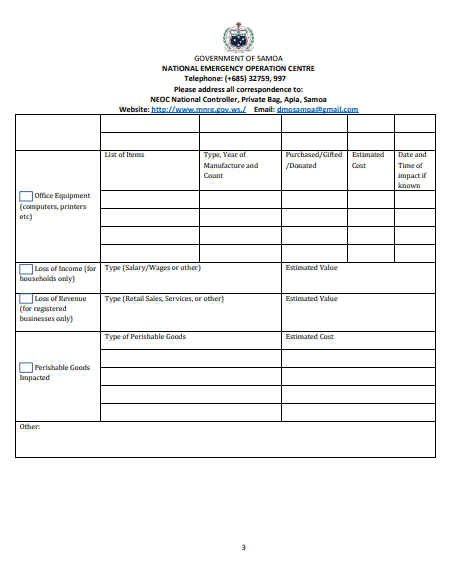
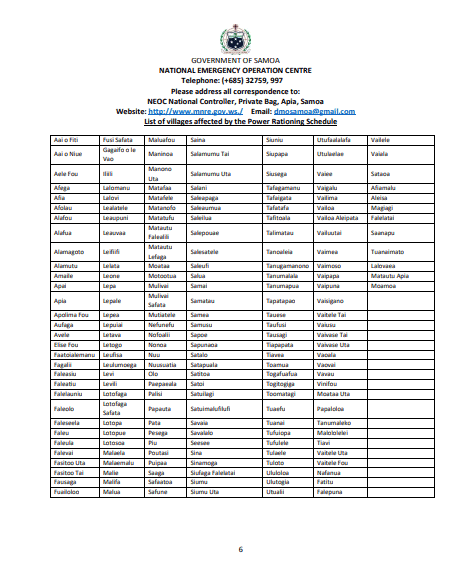
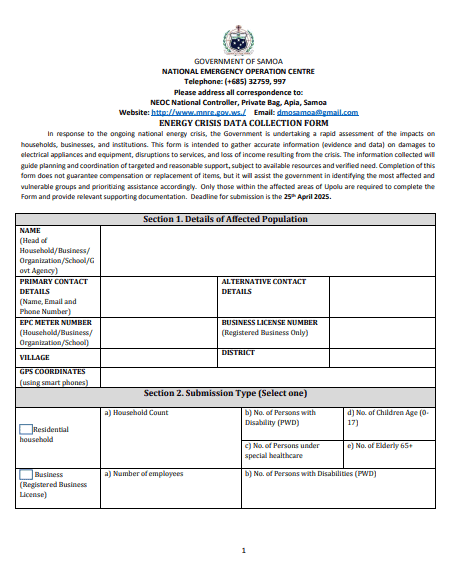
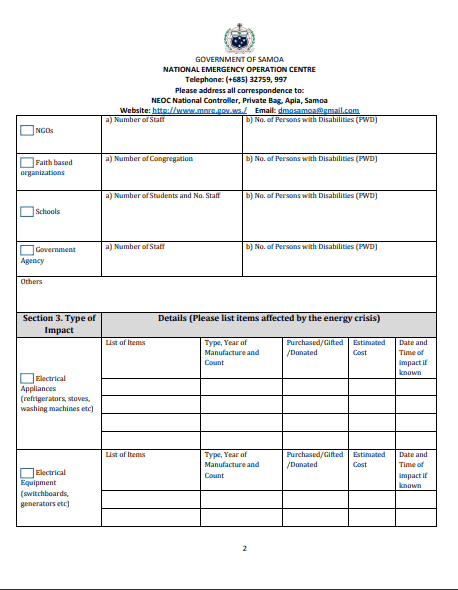
The Government is conducting an official assessment to better understand the energy crisis’s impacts on households, businesses, and institutions. Only residents and businesses in designated areas of Upolu are required to complete the form by 25 April 2025.

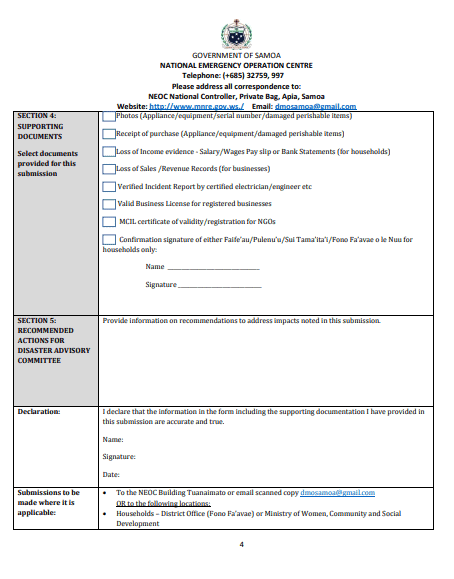
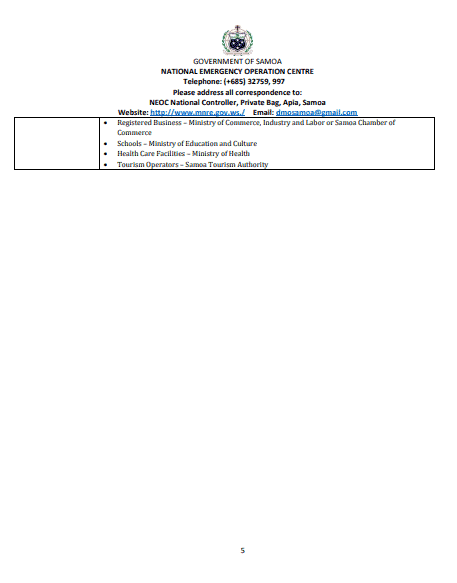
The form will collect information on electrical equipment damage, disruptions to operations or services and financial losses. All Applicants are required to provide their EPC meter number, supporting documentation (e.g., photos, receipts, or certified assessments) for verification.

Download Assessment Form Here

Share this:

LCQ3: Electric vehicle charging facilities

Source: Hong Kong Government special administrative region

LCQ3: Electric vehicle charging facilities 
Question:
 
     It is learnt that the demand for electric vehicle (EV) charging facilities has continued to increase in recent years, and the Government will launch the Fast Charger Incentive Scheme (the Incentive Scheme) to subsidise the installation of fast charging facilities by the private sector. Furthermore, the community also hopes that more fast charging facilities can be provided in government premises. In this connection, will the Government inform this Council:
 
(1) given that the Government is retrofitting charging facilities for about 7 000 additional parking spaces in government premises, of the progress of the relevant works and the number of quick chargers to be retrofitted; whether it will launch a new scheme to install quick chargers in government premises; if so, of the details; if not, the reasons for that;
 
(2) given that the EV-charging at Home Subsidy Scheme (EHSS), which subsidises the installation of EV charging facilities in car parks of private housing estates, has ceased to accept applications since the end of 2023, whether the Government will make further funding injection to re-launch the EHSS; if so, of the details; if not, the reasons for that; and
 
(3) whether it will increase the amount of subsidy under the Incentive Scheme to encourage commercial organisations to install fast charging facilities in districts where there are fewer EV chargers, so that chargers will be more evenly distributed among the 18 districts across the territory; if so, of the details; if not, the reasons for that?
 
Reply:
 
President,
 
     To improve air quality and reduce carbon emissions, the Government is committed to promoting the use of electric vehicles (EV). In recent years, Hong Kong has achieved remarkable results in the popularisation of EV. The number of EV was eightfold from about 14 000 five years ago to about 110 000 at the end of last year. Currently, about seven out of every 10 newly registered private cars are electric private cars (e-PC), and the growth rate is among the highest in the world.
 
     Charging network is very important in promoting the popularisation of EV. It would be most convenient for e-PC and light vehicles to be charged at the car owners’ residence, workplace, or frequently visited parking spaces. Due to their longer parking time, fast charging is not necessary. As for commercial EV, such as electric taxis, a quick or even fast charging network is necessary. As of March 2025, Hong Kong had nearly 100 000 parking spaces equipped with charging infrastructure. There are 11 180 public charging facilities, of which about 2 000 are quick or fast charging facilities. We will continue to adopt a multi-pronged approach to increase charging facilities, including converting conventional petrol filling stations (PFS) into fast charging stations or retrofitting PFS with fast charging facilities.
 
     My responses to the Hon Jimmy Ng’s three questions are as follows:
 
(1) The Chief Executive’s 2022 Policy Address proposed to provide charging facilities in 7 000 additional parking spaces in government premises. As of March 2025, 4 158 chargers have been installed. Relevant departments have reviewed the progress of the remaining works, and the target can be achieved by the end of 2025.
 
     The Government adding EV charging facilities in its car parks mainly to facilitate charging of EV parked there. Vehicles parked in car parks generally have a longer time to charge. The cost of fast chargers is much higher than that of medium chargers. To make optimal use of resources, the EV charging facilities currently added to government car parks are mainly medium chargers. Among the 4 158 chargers, there are 27 quick or fast chargers which are mainly used as pure charging spaces rather than parking spaces.
 
(2) The EV-charging at Home Subsidy Scheme (EHSS) was launched in October 2020 with two phases, with a total funding subsidy of $3.5 billion. The Environmental Protection Department completed the vetting of all applications in the first quarter of 2024, with a total of 724 applications approved. As of the end of April 2025, 42 020 parking spaces have completed the installation of EV charging infrastructure. It is expected that the number of parking spaces with installation works completed will increase to about 77 000 by the end of this year. Through the EHSS and by the end of the 2027-28 financial year, EV charging infrastructure will be installed in about 140 000 parking spaces in the carparks of existing private residential buildings or housing estates.
 
     In order to prepare for the large-scale use of EV in the future, the Government began as early as in 2011 to encourage the installation of EV charging infrastructure in parking spaces in newly built private housing estates by tightening the exemption for calculating the gross floor area of ​​buildings. To date, more than 93 700 relevant parking spaces have been approved. Together with the EHSS, it is estimated that more than 200 000 private building parking spaces will be equipped with charging infrastructure by mid-2027. As the number of EV increases, there are already services in the market to provide installation of EV charging facilities in housing estates, so there is no need to inject funds to extend the EHSS.
 
(3) There are currently 169 PFS distributed across the territories in Hong Kong, with the number in each district varying significantly. For example, there are 26 PFS in Yuen Long, the number of which is about nine times of that of Tsuen Wan of three PFS only. Hong Kong is not a large place, and today’s fuel vehicles can refuel across regions with no difficulties. For EV users, it is more practical to increase the number of charging facilities as soon as possible. Therefore, the Government’s strategy at this stage is to make the most use of the market in installing fast charging facilities as soon as possible, improve the convenience of EV users, and at the same time promote market competition to keep the price of EV charging at a reasonable level.
 
     In this regard, the Environment and Ecology Bureau has set up an interdepartmental working group to co-ordinate and resolve difficulties encountered by various parties in setting up charging facilities, with a view to expanding Hong Kong’s EV charging network as soon as possible. In addition, to help EV drivers find the most convenient location to charge their vehicles, we will provide real-time information on public charging facilities through various mobile applications.
 
     The Chief Executive’s 2024 Policy Address announced that the Government will earmark $300 million for a fast charging facility incentive scheme, with the target of providing 3 000 fast chargers to support some 160 000 EV additionally. It is expected that all fast chargers will be put into service gradually from 2026 to the end of 2028.
 
     We consulted the Panel on Environmental Affairs of the Legislative Council on the scheme on January 20 this year, and further optimised the scheme in response to Members’ views, including simplifying the application procedures to reduce administrative costs and shorten approval time. Under the scheme, each newly installed fast charger can receive a subsidy of $100,000, and each applicant can receive a maximum subsidy of $20 million, or subsidy for a maximum of 200 chargers. The applicants are required to arrange land and electricity supply on their own and bear the relevant costs. Subsidised fast chargers must provide electronic payment options and adopt an energy-based fee-charging mode. In addition, subsidised organisations are required to provide real-time information on the usage of relevant chargers and charging fees, and purchase public liability insurance, etc. We are now finalising the implementation details of the scheme and expect to launch and start accepting applications starting from next month.
 
     Thank you, President.
Issued at HKT 12:46

NNNN

FAO SRC REMARKS FOR – UPOLU LAUNCH OF PIG TRAPS

Source:

Share this:

Reverend Laupama Solomona,

Honorable Minister of Agriculture and Fisheries, Niuava Eti Malolo,

Honorable Members of Cabinet,

Members of Parliament

Chief Executive Officer of the Ministry of Agriculture and Fisheries, Seuseu Dr. Joseph Tauati,

Chief Executive Officer of the Scientific Research Organization of Samoa,

Distinguished guests and beneficiaries,

Ladies and gentlemen,

Talofa lava and warm greetings to you all.

It is both an honor and privilege for me to be here with you all in the presence of all dignitaries on this important occasion. On behalf of the Food and Agriculture Organization of the United Nations, FAO, I dedicate to all Samoan friends this official launch of the wild pig traps with the Ministry of Agriculture and Fisheries, Samoa, under the Sustainable Transformation of Domestic Agrifood Systems, STODAS Project.

This initiative is made possible through FAO with generous funding from the European Union. Today marks an important step forward in addressing the persistent challenges faced by our communities – particularly the damage caused by wild and feral pigs to crops and food sources.

The provision of these traps represents a timely and practical solution, aimed at improving food security, protecting livelihoods, and promoting sustainable agriculture. We commend the leadership of the Ministry of Agriculture and Fisheries who have taken the lead in coordinating the distribution of the traps.

Their strong commitment to supporting farming communities ensures that these resources are delivered effectively and equitably to the intended beneficiaries.

To the recipients here today – your presence and participation are deeply appreciated. Your commitment to improving your communities and safeguarding your agricultural resources is at the heart of this initiative, and we are proud to stand with you through this collaboration between Samoa, FAO, and the EU.

As they say, a taro saved is a taro produced. So let us work together to see that through a shared and concerted effort that we address this problem of food loss through proper installation, monitoring and maintenance of these pig traps. FAO would like to work closely with MAF to develop good case studies on the issue of feral pig management as this is a problem faced by many across Samoa and the Pacific region.

Good learnings from this intervention will have long term implications for us all. I seek your support in this endeavor and wish you all well. Let us continue to move forward in partnership, united in our shared goal of sustainable development and food security for all.

May today’s launch be a step forward in building a more resilient, food-secure, and thriving agrifood system for Samoa.

FA’AFETAI LAVA

Share this:

LCQ4: VIP lounge services at Hong Kong International Airport

Source: Hong Kong Government special administrative region

​Following is a question by the Hon Gary Zhang and a reply by the Secretary for Transport and Logistics, Ms Mable Chan, in the Legislative Council today (May 14):

Question:

It has been reported that the passenger throughput at Hong Kong International Airport (HKIA) reached 5.28 million in January this year, with an average daily passenger throughput of over 170 000. However, there are views pointing out that the existing VIP lounge services set up by airlines or enterprises at HKIA are unable to meet the demand, resulting in chronic queues. In this connection, will the Government inform this Council whether it knows:

(1) the current number of VIP lounges at HKIA, as well as the respective average daily number of passengers served and maximum capacity, floor area and year of opening; whether the Airport Authority Hong Kong (AAHK) will consider allowing enterprises to re-establish VIP lounges on the Arrivals Level in response to the increased passenger throughput due to the expansion of HKIA; if so, of the details; if not, the reasons for that;

(2) the number of additional VIP lounges planned to be provided in HKIA’s Terminal 1 in the next five years, together with their respective area, target average daily number of passengers to be served and maximum capacity; the eligibility criteria, approval standards, procedures and time required for applications to establish or expand VIP lounges; and

(3) the number of VIP lounges planned to be established after the expansion of HKIA’s Terminal 2; the respective location, area, target average daily number of passengers to be served and maximum capacity of these VIP lounges and their opening dates?

Reply:

President,

Hong Kong is an international aviation hub. This positioning is recognised in the National 14th Five-Year Plan and the Outline Development Plan for the Guangdong-Hong Kong-Macao Greater Bay Area. To this end, the Government of the Hong Kong Special Administrative Region and the Airport Authority Hong Kong (AAHK) have been taking measures to continuously enhance the strengths and competitiveness of Hong Kong International Airport (HKIA).

With regard to passenger services, the efficiency of airport operations and the passenger experience are our keys to success. Taking into account the large number of passengers, who are of different backgrounds and with different travel purposes, received by the airport every day, the AAHK has been providing a wide range of facilities and services at HKIA, and has been continuously reviewing and striving to improve the facilities to cater for the needs of different groups of passengers. In particular, to cater for the needs of high-end and business travellers, the AAHK has reserved locations in the Passenger Terminal Building of HKIA for airlines or other corporations to set up and operate lounges in accordance with the market demand and commercial modes, with a view to providing travellers with a more superior and comfortable travel experience.

With regard to the matters relating to the lounges in the question, having consulted the AAHK, my reply is as follows:

(1) At present, there are 17 lounges at HKIA, including nine lounges operated by airlines for use by designated passengers of the airlines and their alliances, and eight other lounges operated by other non-airline corporations, which are open to passengers on a pay-per-visit basis or on other prescribed modes.

These lounges, which first started operation in 1998, range in size from less than 200 square metres to over 6 000 square metres. The location, size and establishment year of each lounge are set out at the Annex. As regards the service capacity, the 17 lounges mentioned above can receive a total of about 22 000 visitors per day on average, and are currently receiving about 16 000 visitors per day. As the numbers of visitors received by each individual lounge involve commercially sensitive information of the operators, the AAHK is not positioned to provide such information.

Taking into account the fact that departing or transfer passengers generally stay in the restricted area of the airport for a longer period of time to wait for boarding and departure, and that most arriving passengers leave the airport for the urban area expeditiously upon their arrival in Hong Kong, the AAHK has mainly reserved spaces for lounges on the Departures Level of the restricted area to cater for the needs of passengers waiting for their flights. At present, all the 17 lounges at HKIA are located on the Departures Level of the restricted area of Terminal 1 for use by departing or transit passengers. That said, in view of the demand of some arriving passengers for lounge services, there were previously two lounges in the original Terminal 2. The AAHK has reserved spaces for re-establishing two lounges in the Arrivals Hall of the expanded Terminal 2. The proposed lounges will be located outside the restricted area and adjacent to Terminal 1, which will facilitate the reception of passengers arriving via either terminals.

(2) and (3) With the increasing number of high-end passengers, the AAHK has been maintaining communication with airlines and other related corporations, and negotiating with airlines and other corporations interested in setting up, expanding and refurbishing lounges on the leasing arrangements as well as the related operational details, so as to ensure that the facilities of the airport lounges can meet the demand of passengers.

With regard to Terminal 1, the AAHK has already received and approved expansion plans for two lounges currently operated by airlines, with their areas be increased by about 4 200 square metres. One of the lounges will be refurbished and expanded within this year and will reopen in 2027, while the other will commence expansion works in 2028 and reopen in 2030. Meanwhile, the AAHK has reserved another three locations on the Departures Level for the operation of new lounges and is in discussion with a number of airlines with a view to bringing the lounges into operation progressively from this year onwards. The total area of the three lounges is about 2 300 square metres.

For the expanded Terminal 2 and the Terminal 2 Concourse (T2C), the AAHK is now working with its business partners on the preparatory work and will commission the facilities in phases in accordance with passenger demand. Of them, the abovementioned two lounges at the Arrivals Hall, with a total area of about 1 000 square metres, are expected to come into service in phases to tie in with the phased opening of Terminal 2 from end of this year. The AAHK has also reserved spaces on the Departures Level for seven lounges, with a total area of about 6 000 square metres, which will come into operation gradually to tie in with the opening of T2C.
​
President, overall speaking, apart from continuously improving and upgrading airport facilities (e.g. lounges), we have also adopted a multi-pronged approach to enhance the passenger experience at the airport, which includes adopting a number of measures such as increasing efficiency through the use of innovative technology, enhancing the customer service standard of airport staff, and increasing the variety of shopping and dining options at the airport, with a view to providing passengers with more comfortable and convenient services.
LCQ7: Government public transport fare concession scheme

Source: Hong Kong Government special administrative region

     Following is a question by the Hon Michael Tien and a written reply by the Secretary for Labour and Welfare, Mr Chris Sun, in the Legislative Council today (May 14):
 
Question:
 
Starting from August 25 last year, people aged 60 or above must use the JoyYou Card to enjoy a concessionary fare of $2 per trip under the Government Public Transport Fare Concession Scheme for the Elderly and Eligible Persons with Disabilities (the new measure). In this connection, will the Government inform this Council:
 
(1) whether it knows the number of contravention cases uncovered by the MTR Corporation Limited involving the use of JoyYou Card to enjoy the concessionary fare of $2 since the implementation of the new measure and, among such cases, the number of those referred to the Police for follow-up;
 
(2) in respect of the cases referred to the Police for follow-up as mentioned in (1), of the respective numbers of cases prosecuted and not prosecuted by the Police; the reasons for the Police not prosecuting such cases; and
 
(3) in respect of the prosecution cases mentioned in (2), of the number of convicted persons who were eventually sentenced to imprisonment?
 
Reply:
 
President,

The Government has implemented in full a real-name registration system for the Government Public Transport Fare Concession Scheme for the Elderly and Eligible Persons with Disabilities (the $2 Scheme) starting from August 25, 2024, mandating Hong Kong residents aged 60 or above to use a JoyYou Card, and eligible persons with disabilities aged below 60 to use a Personalised Octopus card encoded with the “Persons with Disabilities Status”, to enjoy the $2 Scheme.
 
The Transport Department (TD) has all along been requesting public transport operators (PTOs) to strengthen ticket inspection and passenger identity verification work and to strictly enforce the penalty as set out in relevant legislation and by-laws to prevent any abuse. The TD also conducts surveys and monitors the situation. The TD also conducts joint inspection and enforcement actions with PTOs from time to time and refers abuse cases with sufficient evidence to the Police for criminal investigation so as to achieve deterrent effect.
 
In respect of the enforcement actions carried out by the MTR Corporation Limited (MTRCL) during the period from the full implementation of the real-name registration system to April 2025, the number of abuse cases of the $2 Scheme with surcharges imposed was 280 (i.e. eight cases per week on average). The number of cases concerned has been lowered significantly as compared to the 9 624 cases (i.e. 158 cases per week on average) before the implementation of the real-name registration system from June 25, 2023, to August 24, 2024.
 
After the full implementation of the real-name registration system, the MTRCL had sought assistance from the Police for 14 suspected cases of abuse of the $2 Scheme using JoyYou Card. Police officers were deployed to the scene for each case. Among the 14 cases, five arrests were made after investigation by the Police. One of those arrest cases had completed prosecution (with the arrested person convicted of theft and fined $400), while the arrested person of another case was prosecuted by the Police for theft (with the hearing taking place on May 9, 2025) and two cases are still under investigation. Another case was referred to the MTRCL for follow-up as a case of violation of the Mass Transit Railway By-laws since no criminal elements were found after investigation by the Police. The remaining nine cases had also been referred to the MTRCL for follow-up as cases of violation of the Mass Transit Railway By-laws since no arrestable offences were identified after investigation by the Police.

LCQ13: Incident handling by MTR Corporation Limited

Source: Hong Kong Government special administrative region

Following is a question by the Hon Carmen Kan and a written reply by the Secretary for Transport and Logistics, Ms Mable Chan, in the Legislative Council today (May 14):

Question:(i) the nature, cause, delay time, recovery time, remedial measures taken and number of passengers affected for each incident; and
(ii) the number of incidents of service disruption of 31 minutes or above caused by factors within the control of MTRCL under the Service Performance Rebate, and their percentage of the total number of incidents in that year;

LCQ18: Manpower of lifeguards

Source: Hong Kong Government special administrative region

Following is a question by the Hon Luk Chung-hung and a written reply by the Secretary for Culture, Sports and Tourism, Miss Rosanna Law, in the Legislative Council today (May 14):
 
Question:
 
There are views pointing out that the problems of insufficient manpower and recruitment difficulties of lifeguards in Hong Kong have remained unresolved for many years, which may lead to the chaotic situation of unlicensed lifeguards being employed, undermining the dignity of the industry’s workforce and jeopardising the lives and safety of swimmers. In this connection, will the Government inform this Council:
 
(1) of the current number of vacancies of civil service lifeguards; whether the Government has assessed the impact of the vacancy situation on the services to the public;
 
(2) whether it has studied if the Government has difficulties in recruiting lifeguards; if it has studied and the outcome is in the affirmative, of the support measures and proposals to resolve the problem;
 
(3) as some members of the industry have relayed that at present, civil service lifeguards have limited promotion prospects and their remuneration packages are inadequate, and their posts are only included in the Artisan grade, but they have to obtain a number of certificates and regularly renew their licenses in order to be employed on a continuous basis, which has resulted in a high wastage rate and stifled the development of the industry, whether the Government will further review and adjust the grade structure of civil service lifeguards, thereby retaining talents and attracting new blood to join the industry;
 
(4) of the respective numbers of (a) surprise and (b) non-surprise (i) inspections of private swimming pools conducted by the relevant government departments in the past three years, and the respective numbers of non-compliance cases found during such inspections in which (ii) there was insufficient manpower on duty at the swimming pools, and (iii) unqualified lifeguards were employed and on duty (set out in the table below); the actions taken by the Government to pursue such non-compliance cases;

Year (a) (b)
(i) (ii) (iii) (i) (ii) (iii)
2022            
2023            
2024            

(5) as it has been reported that the Food and Environmental Hygiene Department (FEHD) will check the identity documents and Pool Lifeguard Awards (PLA) of the lifeguards on duty during inspections of private swimming pools and verify the validity of PLA with the Hong Kong China Life Saving Society (HKCLSS), of the specific procedures adopted by the FEHD for verifying the validity of the PLAs with the HKCLSS, including whether the FEHD has established a formal and regular liaison mechanism with the HKCLSS; if so, of the details; if not, whether it will consider establishing such mechanism; and
 
(6) as it has been reported that the HKCLSS intends to introduce an online service for checking the qualifications of lifeguards, whether the Government will collaborate with the HKCLSS to establish a checking system for qualified lifeguards, so as to rigorously combat unlicensed lifeguards and, at the same time, facilitate employers in checking the qualifications of the lifeguards they employ?
 
Reply:
 
President,
 
In consultation with relevant policy bureaux and government departments, the consolidated reply to the questions raised by the Hon Luk Chung-hung is as follows:
 
(1) The Leisure and Cultural Services Department (LCSD) is responsible for managing 46 public swimming pools, 42 gazetted beaches (Note 1) and five water sports centres. As at May 1, 2025, a total of 1 308 civil service lifeguards were employed by the LCSD. The number of vacancies was 188 (Note 2) .
 
During the swimming season every year (i.e. April to October), the LCSD needs to employ about 700 seasonal lifeguards. However, with increasing market demand for lifeguards due to the growing number of local private swimming pools in recent years, it has become more challenging for the LCSD to recruit seasonal lifeguards, which inevitably affects the provision of services at aquatic venues. The LCSD has all along flexibly deployed its serving lifeguards and other resources with a view to maintaining the services provided at aquatic venues as far as possible. The LCSD will arrange sufficient lifeguards to be on duty at aquatic venues that are open and deploy additional manpower when necessary, such as calling off-duty lifeguards to report for duty or arranging lifeguards to work overtime where practicable. Having regard to the usage of swimming pools and habits of swimmers, the LCSD will also temporarily close facilities with low usage rates during sessions with fewer attendees to optimise the use of manpower resources.
 
(2) The LCSD proactively puts in place various measures to increase and stabilise the manpower supply of lifeguards, including improving the remuneration package of seasonal lifeguards, enhancing the flexibility of recruitment procedures and exploring the recruitment of more eligible persons to join lifesaving services, etc.
 
The LCSD has recruited 110 full-year lifeguards on a two-year contract since 2023, and further employed 70 additional full-year lifeguards on a two-year contract in 2024 and 2025 respectively. Such relatively long contract period is conducive to stabilising the manpower supply of lifeguards. The LCSD has also taken into account market trends to further enhance the remuneration package of seasonal lifeguards, with monthly salary reaching as high as $23,000 (excluding end-of-contract gratuity) to reduce the salary gap between lifeguards in the public and private sectors.
 
Furthermore, as contractors of outsourced services offer more flexibility on remuneration packages and working hours, which makes the recruitment arrangement more flexible and attractive, the LCSD has outsourced lifesaving and first aid services at six public swimming pools on a trial basis since September 2024. The relevant service contractor has been providing stable lifesaving and first aid services. The LCSD will continue to review and evaluate the effectiveness of outsourcing lifesaving and first aid services.
 
As for expanding the new labour markets, the LCSD will continue to step up its publicity efforts for recruitment exercises, including extensively displaying recruitment posters and disseminating recruitment information/advertisements to reach out to more target groups. The LCSD will also proactively liaise with youth services organisations and schools to promote and encourage young people to pursue a career in lifeguarding, as well as to raise their interests in working as seasonal lifeguards, with a view to increasing the manpower supply of lifeguards. Besides, the LCSD launched the “Combined Seasonal Lifeguard Training Scheme” in 2023 and has so far organised six “Integrated Certificates Courses on Life Saving” to attract more people with no lifesaving qualifications to join the profession. In addition, the LCSD has collaborated with the Employees Retraining Board to organise specific lifesaving training programmes and provide relevant job opportunities with a view to increasing the manpower supply of lifeguards.
 
(3) Under the prevailing policy of the Civil Service Bureau (CSB), when a specific civil service grade has proven and persistent recruitment and retention difficulties, or fundamental changes in the job nature, job complexity and responsibilities, the Government will consider conducting a grade structure review for the grade concerned. There have been no fundamental changes to the job nature, job complexity and responsibilities of civil service lifeguards. In the past three years, the average vacancy rate of civil service lifeguards was 5.28 per cent, which was lower than the rate of 9.38 per cent for the entire civil service in the same period. The LCSD will continue to monitor the situation with the CSB.
 
(4), (5) and (6) In the past three years, the number of surprised inspections conducted by the Food and Environmental Hygiene Department (FEHD) on licensed swimming pools is provided below:
 

  Number of inspections Number of cases of insufficient number of personnel on duty Number of non-compliance cases involving
employment of unqualified lifeguards
2022 8 845 0 0
2023 8 834 0 0
2024 12 828 4 0

As all inspections conducted by the FEHD on licensed swimming pools are surprise inspections, there is no record on non-surprise inspections.
 
For the four cases in 2024 in which sufficient number of qualified lifeguards was not made available in accordance with the law or licensing conditions, the FEHD had taken prosecution or issued warnings to the licensees depending on the actual situation.
 
The lifesaving qualifications required by lifeguards are assessed and awarded by the Hong Kong China Life Saving Society (HKCLSS) (Note 3). Starting from May 19, 2025, the FEHD will implement a number of measures to strengthen the monitoring of the qualifications of lifeguards at private swimming pools. These measures include stepping up inspections of swimming pools. Apart from checking the identity documents of lifeguards on duty and their Pool Lifeguard Awards (PLA) during each surprise inspection, the FEHD will also send all information of the PLA to the HKCLSS for verification. The FEHD and the HKCLSS have established a regular verification mechanism to handle the matter.
 
Note 1: Lifesaving services are not provided by the LCSD at three of the gazetted beaches as beach facilities such as beach buildings and shark prevention nets are not available there.
Note 2: With lifesaving and first aid services being outsourced at six public swimming pools under the LCSD on a trial basis since September 2024, the 98 civil service lifeguard vacancies in the venues concerned will not be filled for the time being.
Note 3: The HKCLSS is the only national sports association recognised by the International Life Saving Federation for assessing lifeguard qualifications and awarding lifeguard certificates in Hong Kong.

LCQ21: Deepening international exchanges and co-operation

Source: Hong Kong Government special administrative region

LCQ21: Deepening international exchanges and co-operation 
Question:
 
     In the country’s Report on the Work of the Government this year, it was mentioned that Hong Kong must deepen international exchanges and co-operation. The Hong Kong Special Administrative Region Government is also actively attracting overseas companies to Hong Kong and helping Mainland companies go global to align with the overall development strategy of the country. In this connection, will the Government inform this Council:
 
(1) how it will promote alignment between Hong Kong’s financial services industry and national policies to leverage Hong Kong’s unique advantages, reinforce its connectivity with both the Mainland and the world, and actively promote international exchanges and co-operation; whether it will consider providing further support to financial services enterprises to expand into new markets and broaden their international networks;
 
(2) as it is learnt that many Hong Kong enterprises, business associations, non-profit organisations, and international trade organisations possess extensive overseas networks, whether the Government has compiled the relevant statistics; if so, of the details; how the Government will leverage the power and resources of non-governmental organisations to foster citizen diplomacy;
 
(3) to align with the country’s overall development strategy, will the Government review and optimise the division of responsibilities and functions of different government departments or public organisations responsible for promoting trade (such as the Economic and Trade Offices, the Hong Kong Trade Development Council, Invest Hong Kong, and other overseas offices), so as to avoid overlapping structures and enable them to focus more on delivering services under existing policies;
 
(4) whether the Government will formulate specific policy measures to support and sponsor various enterprises and organisations to participate in industrial and commercial, and financial exhibitions, etc, in overseas countries in order to promote commercial co-operation with Middle East countries and Belt and Road countries, and to promote Hong Kong to such countries; if so, of the details; if not, the reasons for that; and
 
(5) whether the Government has a comprehensive plan to tell good stories of Hong Kong to the outside world through targeted publicity and promotion strategies, and to better leverage Hong Kong’s international advantages to attract more international financial institutions and investors to establish presence in Hong Kong?
 
Reply:
 
President,
 
     Having consulted the Financial Services and the Treasury Bureau, the consolidated reply to the question raised by the Hon Robert Lee is as follows:
 
     The Outline of the 14th Five-Year Plan for National Economic and Social Development of the People’s Republic of China and the Long-Range Objectives Through the Year 2035 (14th Five-Year Plan) supports Hong Kong to enhance its status as an international financial centre, strengthen its functions as a global offshore Renminbi (RMB) business hub, an international asset management centre and a risk management centre, as well as deepen and expand the mutual access between the financial markets of the Mainland and Hong Kong.
 
     In this regard, the Hong Kong Special Administrative Region (HKSAR) Government has been committed to deepening the interface of Hong Kong’s financial services industry with national policies in accordance with the 14th Five-Year Plan. For example, in terms of mutual market access, the Stock Connect has made some breakthroughs over the past few years, including the inclusion of exchange-traded funds and the addition of eligible stocks of foreign companies primarily listed in Hong Kong. This has become the most reliable channel for international investors to access the Mainland securities market. In terms of global offshore RMB business, at present, Hong Kong has the world’s largest offshore pool of RMB funds, currently processing about 80 per cent of global offshore RMB payments. On attracting Mainland enterprises to list in Hong Kong, as driven by a series of listing enhancement measures, there are currently over 1 480 Mainland enterprises listed in Hong Kong. The Hong Kong Exchanges and Clearing Limited (HKEX) has established listing avenues for new economy with weighted voting rights structures, and specialist technology companies as well as the technology enterprises channel, with a view to accurately addressing the financial service demands of Mainland’s emerging innovation and technology industries and leveraging Hong Kong’s strengths to serve our country’s needs.
 
     We also continue to deepen exchanges and co-operation with the global financial community, actively strengthen and expand our circle of friends with the global community, organise major financial events of global significance such as the Asian Financial Forum, the Wealth for Good in Hong Kong Summit and the Global Financial Leaders’ Investment Summit, in a bid to further enhance the voice and influence of our country and Hong Kong in the international financial community and showcase to the international investors the strengths and opportunities of Hong Kong as an international financial centre.
 
     In addition, the HKSAR Government, regulators and the HKEX are committed to promoting Hong Kong’s financial services industry, securities market and fundraising platform to overseas and Mainland enterprises and investors (including target markets such as the Middle East and the Association of Southeast Asian Nations regions), through organising and participating in different thematic flagship summits, outreach activities, thematic roadshow events, etc, with a view to strengthening Hong Kong’s linkage with overseas and Mainland markets, fostering financial market co-operation, as well as facilitating the local financial services industry to open up new markets.
 
     We will continue to deepen and step up our efforts to seize the national development opportunities, bringing more new opportunities to the industry and continuing to contribute to our country’s development as a financial powerhouse.
 
     On the other hand, the HKSAR Government has been actively promoting the sustainable development of Hong Kong as an international trade centre through diversified measures. The global trade landscape and geopolitics are rapidly changing, with parts of the supply chains shifted to the Global South and Belt and Road (B&R) countries, while Mainland enterprises are also proactively establishing their presence abroad. Hong Kong’s rich experience in international trade and world-class professional services will be of assistance to such Mainland enterprises in re-deploying their global supply chains. According to the 2024 Policy Address, Invest Hong Kong (InvestHK) and the Hong Kong Trade Development Council (HKTDC) set up in December 2024 a high value-added supply chain services mechanism for attracting Mainland enterprises to establish international or regional headquarters in Hong Kong for managing offshore trading and supply chain, and providing one-stop professional advisory services for enterprises in Hong Kong looking to go global. The mechanism is conducive to Hong Kong’s economic development on the one hand, and facilitates the deepening of its international exchanges and co-operation on the other hand, thus responding to meet Premier Li Qiang’s expectations for Hong Kong, as set out in his work report this year, integrating into the overall national development while making contribution to the country.
 
     Besides, the HKSAR Government will continue to organise a number of outbound missions to B&R markets to assist Hong Kong enterprises and professional services to further explore business opportunities and build long-lasting collaborative relationships with relevant local enterprises and organisations. We will also continue to actively organise various major events to promote Hong Kong’s advantages and facilitate business matching and project participation between Hong Kong and B&R countries. In addition, the HKTDC’s overseas network has already covered the major markets along the B&R, including regions of the Middle East. By leveraging its global network, the HKTDC will continue to launch diversified outreach activities, information platforms, large-scale international exhibitions and conventions, to highlight Hong Kong’s opportunities and role as a two-way business and investment platform, and facilitate the co-operation among enterprises of the Mainland and Hong Kong, investors and professional service providers, as well as the project owners from B&R countries.
 
     For overseas exhibitions activities, the HKSAR Government strives to encourage and provide funding support for non-listed Hong Kong enterprises to upgrade and restructure, enhance competitiveness of enterprises as well as sectors and conduct promotional activities through various funding schemes and measures, including the Dedicated Fund on Branding, Upgrading and Domestic Sales, the SME Export Marketing Fund and the Trade and Industrial Organisation Support Fund. Enterprises/organisations could apply for funding to participate in promotional activities such as exhibitions in markets outside Hong Kong to develop their businesses. The HKTDC has also been actively leading Hong Kong companies to participate in large-scale exhibitions overseas and set up Hong Kong pavilions in selected large-scale exhibitions. In addition, the HKTDC offers preferential participation rates and a range of value-added services, including the arrangement of business matching meetings, for Hong Kong companies to grasp the opportunities to promote their products and services.
 
     Currently, the HKSAR Government has 14 overseas Hong Kong Economic and Trade Offices (ETOs). Together with the offices of the HKTDC and InvestHK worldwide, Hong Kong has set up offices in 68 cities around the world, covering 129 countries, including emerging markets. The ETOs, InvestHK’s Dedicated Teams for Attracting Businesses and Talents based in the ETOs and its consultant offices in other locations, as well as the HKTDC’s offices are responsible for different aspects of work, while collaborating from time to time to generate synergy. The trio promote bilateral economic and trade relations between Hong Kong and overseas economies. InvestHK and the HKTDC mainly serve the business community. InvestHK is responsible for promoting inward direct investment to Hong Kong. Through its teams based in Hong Kong, the Dedicated Teams for Attracting Businesses and Talents based in the ETOs, as well as consultant offices in other locations, the department has all along been reaching out to a wide spectrum of companies in different sectors and industries around the world to attract and assist them to set up or expand their businesses in Hong Kong, and offering one-stop customised support services, from the planning to implementation stages. As for the HKTDC, it is responsible for trade promotion as well as facilitating, assisting and developing trade in Hong Kong. Through organising international exhibitions, conferences and business missions, the HKTDC creates business opportunities in the Mainland and international markets for Hong Kong enterprises. The ETOs are committed to maintaining close communication and exchanges with the international community and overseas stakeholders in different sectors (including government officials, think tanks, media organisations, academics, cultural and business groups and other key opinion leaders in countries under their purview), promoting and explaining the HKSAR Government’s important policies and Hong Kong’s unique advantages under “one country, two systems”, with a view to telling the good stories of Hong Kong and promoting economic and trade development between Hong Kong and overseas.
 
     Meanwhile, the ETOs will strengthen ties and co-operation with foreign chambers of commerce in Hong Kong and the local political and business sectors, and take the opportunity of the latter’s overseas visits to collaborate in promoting Hong Kong’s latest developments and major policy measures through different forms of activities, and jointly tell the good stories of Hong Kong from multiple perspectives.
Issued at HKT 15:33

NNNN

LCQ16: Safety of hikers

Source: Hong Kong Government special administrative region

     Following is a question by the Hon Chan Pui-leung and a written reply by the Secretary for Environment and Ecology, Mr Tse Chin-wan, in the Legislative Council today (May 14):
 
Question:
 
     Various hiking trails and country parks in Hong Kong have all along attracted many local people and overseas visitors to go hiking. However, it has been reported that quite a number of hikers are inexperienced or ill-equipped, resulting in frequent hiking accidents, and some of them have even disregarded safety in a bid to “check-in”, which has aroused concerns and worries in society. In this connection, will the Government inform this Council:
 
(1) of the number of mountain search and rescue (S&R) calls received by the Government in the past two years, as well as the respective numbers of casualties of local people and overseas visitors involved in the relevant incidents; the government expenditures involved in the relevant calls and S&R operations;
 
(2) given that the webpage of the Agriculture, Fisheries and Conservation Department (AFCD) contains the high risk locations with records of fatal and serious accidents in country parks, whether the authorities have further drawn up a list of “hiking blackspots” and the points to note and stepped up publicity among members of the public and tourists; if so, of the details; if not, the reasons for that;
 
(3) as it is learnt that in order to deter risk-taking behaviours without regard to the consequences, some places have started to collect rescue fees from hikers, whether the Government will erect fences and warning signs at high-risk locations where hiking accidents frequently occur; whether the authorities will follow the practice of other regions and collect rescue fees from hikers who have accidents despite warnings and seek rescue; if so, of the details; if not, the reasons for that, and whether there are other measures intended to be implemented to deter the risk-taking behaviours concerned; and
 
(4) as it is learnt that the “Enjoy Hiking” mobile application launched by the AFCD is equipped with a “Hiker Tracking Service” which can record the location of users so as to shorten the S&R time after they have an accident, of the number of downloads of the application and, among such downloads, the number of users with Internet Protocol addresses outside Hong Kong; of the measures put in place by the authorities to enhance the promotion of hiking safety among overseas visitors?
 
Reply:
 
President,
 
     The Government attaches great importance to publicising and promoting hiking safety, as well as promoting hiking etiquette and the message of protecting the natural environment to the public and tourists through various channels. Having consulted the Security Bureau, the reply to the question raised by the Hon Chan Pui-leung is as follows:
 
(1) In the past two years, the number of mountain search and rescue calls received by the Fire Services Department (FSD) and the number of casualties involved are tabulated below: 
 

Year Number of mountain search and rescue calls received Number of Injuries (Fatalities)
2023 695 cases 424 (15)
2024 588 cases 345 (15)

 
     The FSD does not keep a breakdown of the number of casualties involving local residents and foreign visitors. As the above rescue operations do not involve additional manpower and salary expenditure, the FSD does not keep a breakdown of the expenditure involved.
 
(2) Through the “Enjoy Hiking” website (hiking.gov.hk), the Agriculture, Fisheries and Conservation Department (AFCD) provides consolidated information of different hiking trails to hikers to facilitate their planning of hiking trips. It also lists 20 high risk locations with records of fatal and serious accidents in country parks (high-risk locations), according to factors such as previous records of serious and fatal accidents, the causes of such accidents, as well as the site conditions, with a view to reminding hikers to avoid accessing those areas. The AFCD will regularly review and update the list of high-risk locations as needed. 

     To promote public awareness on hiking safety, the AFCD regularly organises education activities, including school visits, guided tours, roving exhibitions and game booths at shopping malls and Country Parks Visitor Centres. The AFCD will also disseminate safety information through online videos, social media platforms, websites, and pamphlets distributed at Country Parks Visitor Centres. Concurrently, the Hong Kong Police Force, the FSD, the Government Flying Service and the Civil Aid Service also raise hiker’s awareness on hiking safety through various channels and events.
 
(3) The Government has always accorded top priority to public safety and the protection of people’s life and property. While the Government strongly discourages the public from taking risks to perform dangerous activities, effective, reliable and efficient emergency services will still be provided to people in distress or in need under all circumstances. We do not hope that those in need would hesitate in seeking emergency call services due to any reasons, including levy. The AFCD has also installed warning signs in suitable areas of the high-risk locations to remind hikers to avoid accessing those areas. The AFCD will review the situations of different areas from time to time, modify or add suitable warning signs and barriers where needed. 

(4) As at April 2025, the “Enjoy Hiking” mobile application had been downloaded for over 480 000 times, including approximately 100 000 downloads by users with non-local IP addresses. 

     The AFCD, in collaboration with the Tourism Commission and the Hong Kong Tourism Board (HKTB), has been promoting green tourism and sharing messages on hiking safety and nature conservation through HKTB’s “Hong Kong Great Outdoors” thematic website (www.discoverhongkong.com/eng/explore/great-outdoor.html) and its social media platforms, to ensure that tourists enjoy the countryside in Hong Kong in a safe and nature-friendly manner. Furthermore, the AFCD collaborates with the Hong Kong Economic and Trade Offices in the Mainland and the Forestry Administration of Guangdong Province to promote Hong Kong’s natural scenery and hiking routes, as well as to disseminate hiking safety messages, through their social media platforms in the Mainland.